You know we just don’t recognize the most significant moments of our lives while they’re happening. Back then I thought, well, there’ll be other days. I didn’t realize that that was the only day. – Doc “Moonlight” Graham, to Ray Kinsella in the movie “Field of Dreams”
In the summer of 2003, just before embarking on a family vacation to Minnesota, I pitched an idea to my editors at the Sporting News: A 15th anniversary story about a baseball field in Iowa.
By that point, “Field of Dreams” was already part of baseball lore and 50,000-60,000 people a year were making the pilgrimage to the tiny farm outside of Dyersville, Ia., where the movie was filmed in the summer of 1988.
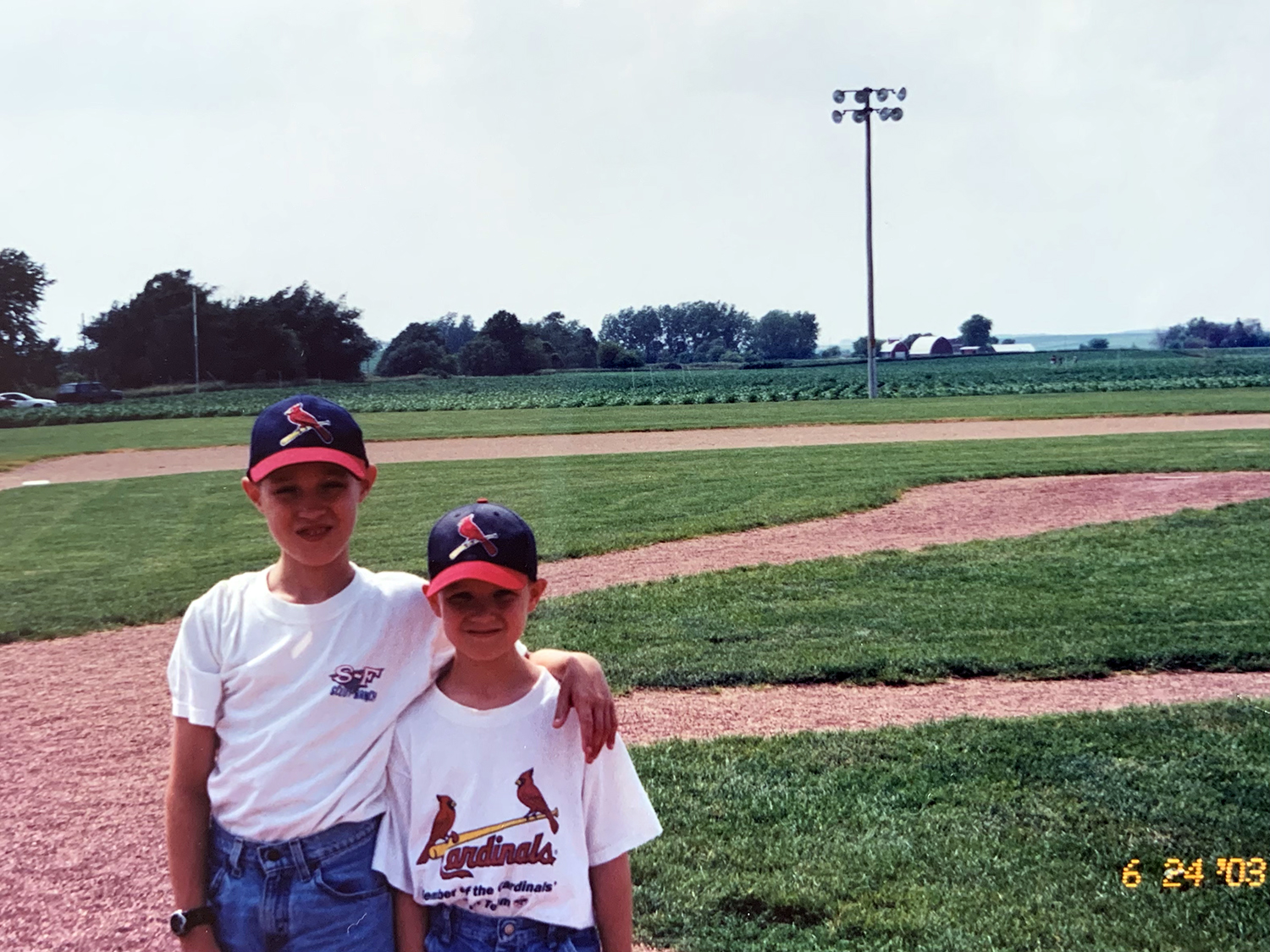
And this was Sporting News calling, so then-owners Don and Becky Lansing were more than gracious to a sportswriter who asked if it would be OK to bring her family along for the interview. It was more than OK. Though they no longer lived in the farmhouse that was used to film the interiors, they met us there, gave us a tour, and offered the porch for the interview. And that’s where I sat talking to the Lansings while Tom, Matt and Jack played catch on the field, frolicked in the corn and acted out scenes from the movie.
Some stories in a career transcend time, and this is one of them. It’s a moment I’ll never forget, watching my husband and our boys, who were 9 and 7 at the time, play on that field – from the same porch where Annie sat watching Ray and his dad have a catch. Sometimes, you do recognize the most significant moments of your life as they’re happening.
Tom and Jack on the field.
Below is the story as it appeared in the July 9, 2003, issue of the Sporting News as well some photos. The Lansings sold the farm in 2011 to a group from Chicago, and the Aug. 12 game between the Yankees and the White Sox has renewed interest in the site. But the movie endures, and I swear every damn time I watch it I get a lump in my throat at the end.
“Field of Dreams” has become part of our family lore, and it’s safe to say if there’s one constant for a family with grown children, it’s baseball. Two of the best moments of this summer of 2021 have happened around baseball: visiting Jack, a St. Louis realtor, in his downtown St. Louis Ballpark Village office; and heading to Chicago to see Matt, an attorney, who surprised his mom with tickets to a baseball game. Which team? The White Sox. Of course.
The entrance to the field.
Jack warming up.
The boys inside the farmhouse.
Don Lansing, then-owner of the farm, makes a bid for the family Christmas card.
A follow up, just as baseball starts up again all over the country, because there’s always more to the story:
Last summer, I wrote about the 60 or so descendants of my mom’s family, the Cliffords, who had gathered in Crestwood Park for a reunion. That same weekend, the Toledo Mud Hens were playing 430 miles away, significant because our common ancestor, my great-grandfather Thomas Clifford, had been an original Mud Hen.
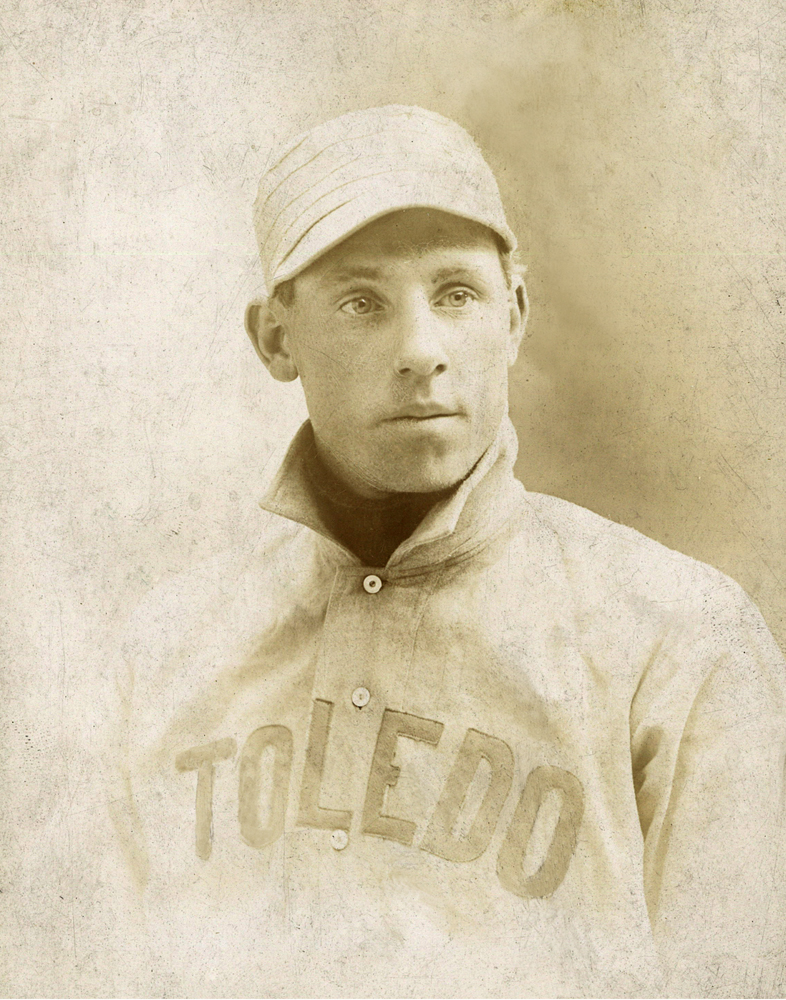
The original photograph.
Or so we always thought. Here’s what we knew: That he had played professional baseball just before the turn of the 20th century, in such cities as Shreveport, Paducah, Peoria and Toledo; and that there existed in the family an old photograph of a handsome young man with a twinkle in his eye and “Toledo” on his jersey.
But this is a story about baseball, where facts are as plentiful as fly balls and not all become legend. Shortly after the reunion, my cousin Mark Meyer, the keeper of the photograph that had been passed down to him from his grandfather, Rich Clifford, emailed the Mud Hens seeking more information.
Mud Hens historian John Husman kindly provided Meyer what stats he had on Clifford and asked for more biographical information. In return, Meyer sent him a digital version (left) of the old picture. And then he forgot about it.
Until last month, when he got this email from Husman: Good Day: We have had the Thomas Clifford image you so kindly gave the Toledo Mud Hens a year ago touched up a bit. A copy is attached for your use. We are displaying it at our ballpark this summer.
The display case at Fifth Third Park in Toledo, Ohio.
Included with the beautifully restored photograph (above left) was the text of a didactic to be placed beside it, telling the story of how Clifford, “versatile on defense,” played in 71 games in 1896 batting .271. But he only played the first half of that Toledo season. That July, the club was sold to a man named Charles Strobel, who, according to Husman, would come to be known as “The Father of Toledo Baseball.” Strobel had owned a team in Washington, and brought with him nearly all his players so he cut most of the Toledo players loose — including my great-grandfather Tom Clifford. Then Strobel changed the nickname from Swamp Angels to Mud Hens.
The display on Thomas Clifford at Fifth Third Park, Toledo, Ohio.
Because of Strobel’s marketing savvy, the club had plenty of photographs of the original Mud Hens. But until my cousin Mark sent his email, it had no pictures of Swamp Angels. Until now.
On Thursday, April 12, the Mud Hens celebrated Opening Day. In a display case at Fifth Third Field in downtown Toledo, amidst baseballs, bats, and Hall of Famer Kirby Puckett on a Wheaties box, now sits a restored replica of a 122-year-old photograph of my great-grandfather, the Mud Hen who never was.
We now know what happened to Tom Clifford. The original story in this blog is here. We always thought he was a baseball player who never made it big. But five generations and hundreds of descendants later, we now know that Tom Clifford, Swamp Angel, made it big enough.
It’s on the record that on June 25, 2017, the Class AAA Toledo Mud Hens lost 4-1 to the Class AAA Columbus Clippers, a fact little noted around these parts unless you happen to be an avid fan of their Major League Baseball parent clubs, the Detroit Tigers or Cleveland Indians.
Thomas E. Clifford, 1896
But while the Mud Hens were playing 430 miles away in Ohio, about 60 descendants of one of their former players were gathering in Crestwood’s Whitecliff Park, south of St. Louis, for a reunion. Funny, crazy Irish people — my people — gathered at Pavilion No. 3, and it was glorious.
That the pavilion lies across the parking lot from a pristine baseball field was no accident because of this: A record on www.baseballreference.com for one Tom Clifford, who played professionally for five seasons from 1895-1900 in places such as Shreveport, La., Paducah, Ken., Peoria, Ill., and Toledo, Ohio.
In between attempting a professional baseball career, the son of Irish immigrants learned how to be a grain inspector and met and married in 1899 a woman named Mary Kennedy. After that, children — eight of them from 1900-1915, seven boys, Thomas, John, Edward, William, Richard, Hugh and Joseph, and one girl, who died in early childhood.
The official baseball record stops in 1900 after the birth of the first child, a boy also named Thomas. Apparently, family won out. Either that, or the reality of a .225 career batting average, probably due to the fact he couldn’t hit a curveball. (It’s always the curveball’s fault.) But at least Tom Clifford gave it a shot, leaving baseball behind in his DNA for what is now five generations.
Twelve of the 14 surviving grandchildren of Thomas Clifford at Whitecliff Park in Crestwood, Mo., June 25, 2017.
Six of Tom and Mary’s eight children survived into adulthood. The boy Thomas, family legend has it, drowned in the Mississippi River on the day of his First Communion. Of the six remaining boys, four would produce among them 15 children, 14 of whom are still with us. It was the children and grandchildren of those 15 who gathered wearing t-shirts in colors distinguishing the four families. The “Eds” wore red, the “Bills” wore green, the “Riches” wore yellow and the “Joes” wore blue, a regular rainbow coalition.
Isn’t that what family is? A mixture of young and old, near and far, colorful and quirky. The oldest, Patty Reckamp, is in her 80s; the youngest were in their 1s. Relatives came from Atlanta, Ga., Chesapeake Va., and from just down the road. The weather couldn’t have been more perfect, nor could the company.
It’s a roll of the dice whenever extended family gets together. But nobody got into any fights nor offered a cold shoulder. People were genuinely happy to be in each other’s company, if only for a short while. Why? Family is what grounds you. It’s good to be reminded of who you are and where you come from before you can figure out where to go next.
If Tom Clifford could have hit the curveball, imagine how different the family might have been. But he couldn’t, and here we were five generations later, still together in the shadow of our own Field of Dreams.
Tom Clifford was an original Mud Hen, quite possibly a reason the picture above exists. For it was in 1896, according to the Toledo club website, that the professional “base ball” team adopted the moniker that would become one of the most unique minor league nicknames in baseball history. Among the club’s most noted alumni are Jim Thorpe, Kirby Puckett, Curtis Granderson and Brandon Inge (Cardinal fans will remember him as the final strikeout at the hands of Adam Wainwright in the 2006 World Series.)
The record referenced above has Tom Clifford playing five seasons throughout the Midwest. Yet there may have been more. His Dec. 20, 1940, obituary in the St. Louis Star Times, written because at the time of his death he was an elected official — constable of the Seventh District — adds more: a managerial stint in New Orleans and a final attempt with the St. Louis Browns in 1904. I’m still working on verifying those details. But that doesn’t take away the thrill of seeing a name in a box score or in the text of a story pictured from an 1896 clipping in the Fort Wayne Gazette titled, “Wonderful.” It’s an account of a game between the Mud Hens and the Fort Wayne Farmers and is must-read not only for the prose, but for the details of the umpiring. You think journalism is biased today? Read it.
And then there’s this: A single line on the bottom row of a 1900 census book, the Twelfth Census of the United States. Amid information about Thomas E. Clifford’s birth (May 1875); birthplace of his parents (Ireland, in both cases); and his status in the household (head) on O’Fallon Street in the 16th Ward in north St. Louis is a column marked “occupation.” There, it says simply, “ball-player.”
The box score is superimposed and highlighted from the article in the second column of the July 1, 1896 Fort Wayne Gazette.
Baseball is clearly in the DNA. Here’s a picture of a baseball team, circa 1920s, with two of Tom’s sons, my maternal grandfather Bill Clifford (kneeling third from left) and his younger brother Rich Clifford (third from right):
Fifteen Baseball Hall of Fame ballots have come into my south St. Louis County home since the year 2000, and my stomach has churned filling out every single one of them.
A little background: It starts in September 1989, the day I walked into The Sporting News offices at 1212 N. Lindbergh Blvd., in St. Louis County. It was among the happiest days of my life. OK, maybe in addition to my wedding day and the birth of my two boys, but beyond that I can’t think of any day happier.
Amidst office décor that screamed 1960s functional, beyond computer wires strewn to and fro and typewriters scattered about, under a cigarette cloud and surrounded by the best collection of sports memorabilia anywhere, I took a deep breath and walked into an office filled with desks bearing nameplates this native St. Louisan had grown up reading and idolizing: Stan Isle, Bob McCoy and Larry Wigge.
It was then-editor Tom Barnidge who hired a young woman just weeks out of Northwestern University’s Medill School of Journalism. One of the first women to break The Sporting News’ editorial staff glass ceiling, I started working as an associate editor at The Bible of Baseball a few days after Bart Giamatti died of a heart attack.
The Sporting News issue that dealt with that tragedy — and Giamatti’s last act as commissioner in banning Pete Rose — was my first one. That fall, Miami Hurricanes football, the Loma Prieta earthquake that interrupted the World Series and a young NASCAR champion named Rusty Wallace all grabbed headlines in the gray, newsprint pages of The Sporting News. Also at that time, as was the custom for the small group of Sporting News editors, I was invited to join the Baseball Writers Association of America (BBWAA). I gladly accepted.
Over the course of the next 17 years, I covered, at various times, college football and college basketball, the NBA, and ultimately – and always – Major League Baseball. I witnessed The Sporting News go from glorious gray pages filled with box scores, statistics and agate type, to a variety of glossy, slick incarnations forced upon it by cable sports television and daily national newspaper. All the while, baseball remained the butter upon which the Sporting News churned, even as glorious publications such as the Baseball Guide, Baseball Register and countless annual yearbooks succumbed valiantly to something called the Internet.
Along the way, I had the privilege to learn and work under some of the finest sports journalists in the country, beginning with Tom Barnidge and then one of the finest gentlemen and mentors I’ve known in John Rawlings. Editors Dennis Dillon, Bob Hille, Celeste Williams, Steve Meyerhoff, Carl Moritz, Bill Marx and Cindy Boren all left indelible marks and taught me immeasurable lessons about journalism. And later, in a decade called the ’90s, I saw the best young talent come through our doors and help us figure out how to convert the Gray Lady into digital content with the likes of Mark Newman, Chris Jenkins, Aimee Crawford, Will Leitch, Sean Deveney and Ryan Fagan – all of whom continue, in one way or another, to take sportswriting to professionally staggering levels. At every stage, I worked with a collection of talent unmatched in journalism circles.
It’s this legacy I have carried with me each year since 2000, the first year I became eligible to vote and I looked at the paper ballot with trepidation and awe. Each year since, I have weighed the nominees carefully and with great consideration. And my great career at the Sporting News comes back to me.
I think about the baseball notes edited at 2 a.m. on a Monday morning on deadline, and the great conversations and arguments in the newsroom. I think about the baseball history I witnessed through the pages of a national magazine, from Pete Rose to Cal Ripken Jr. to Derek Jeter to Albert Pujols. I think about the World Series and All-Star games and clubhouses and pressboxes. I think about a cardboard membership card with the diamond logo that arrived each year in late winter. I think about the players and their legacies, and how that ballot I hold in my hand is one of the most important things I will do in my career. And on a cold December night, typically next to a glowing Christmas tree, I mark my selections and seal the envelope, my heart pounding with each pencil mark.
The voting process is not perfect, but the BBWAA is as much a part of baseball lore as the knuckleball and hitting for the cycle, and I’m honored to be a small part of it. One day, that could change and us honorary voters may get sent down for good. If that happens, it won’t change the fact that for 15 years, I’ve proudly, diligently, and with the utmost reverence to the game, contributed to the Baseball Hall of Fame.
In the meantime, I’ll keep voting as long as I’m asked, one of fewer than 20 women who have the privilege. For the record, my 15th ballot was marked with 10 players – the maximum number allowed. I cast votes for all four inductees, Craig Biggio, Randy Johnson, Pedro Martinez and John Smoltz. In addition, my votes this year went to Jeff Bagwell, Edgar Martinez, Mike Piazza, Tim Raines, Curt Schilling and Lee Smith.
Said Smoltz when he was told of his selection: “I’m honored, I’m humbled …”
So is this voter.
A version of this column appeared in the Jan. 9, 2015 issue of the South County Times.