A follow up, just as baseball starts up again all over the country, because there’s always more to the story:
Last summer, I wrote about the 60 or so descendants of my mom’s family, the Cliffords, who had gathered in Crestwood Park for a reunion. That same weekend, the Toledo Mud Hens were playing 430 miles away, significant because our common ancestor, my great-grandfather Thomas Clifford, had been an original Mud Hen.
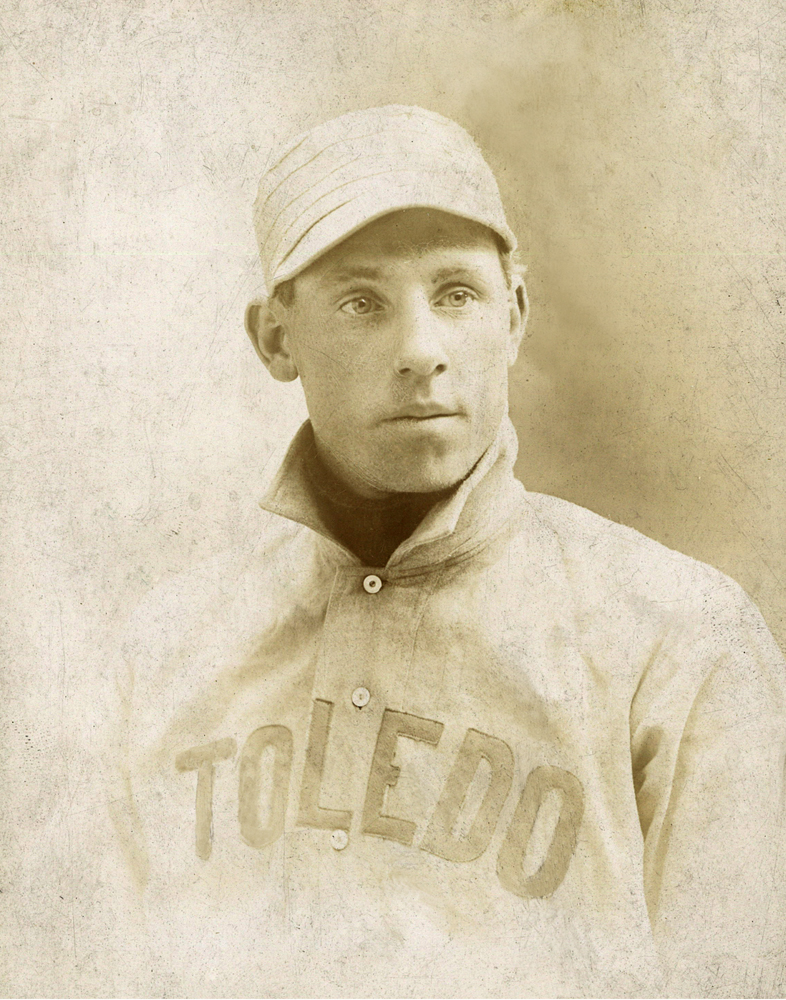
The original photograph.
Or so we always thought. Here’s what we knew: That he had played professional baseball just before the turn of the 20th century, in such cities as Shreveport, Paducah, Peoria and Toledo; and that there existed in the family an old photograph of a handsome young man with a twinkle in his eye and “Toledo” on his jersey.
But this is a story about baseball, where facts are as plentiful as fly balls and not all become legend. Shortly after the reunion, my cousin Mark Meyer, the keeper of the photograph that had been passed down to him from his grandfather, Rich Clifford, emailed the Mud Hens seeking more information.
Mud Hens historian John Husman kindly provided Meyer what stats he had on Clifford and asked for more biographical information. In return, Meyer sent him a digital version (left) of the old picture. And then he forgot about it.
Until last month, when he got this email from Husman: Good Day: We have had the Thomas Clifford image you so kindly gave the Toledo Mud Hens a year ago touched up a bit. A copy is attached for your use. We are displaying it at our ballpark this summer.
The display case at Fifth Third Park in Toledo, Ohio.
Included with the beautifully restored photograph (above left) was the text of a didactic to be placed beside it, telling the story of how Clifford, “versatile on defense,” played in 71 games in 1896 batting .271. But he only played the first half of that Toledo season. That July, the club was sold to a man named Charles Strobel, who, according to Husman, would come to be known as “The Father of Toledo Baseball.” Strobel had owned a team in Washington, and brought with him nearly all his players so he cut most of the Toledo players loose — including my great-grandfather Tom Clifford. Then Strobel changed the nickname from Swamp Angels to Mud Hens.
The display on Thomas Clifford at Fifth Third Park, Toledo, Ohio.
Because of Strobel’s marketing savvy, the club had plenty of photographs of the original Mud Hens. But until my cousin Mark sent his email, it had no pictures of Swamp Angels. Until now.
On Thursday, April 12, the Mud Hens celebrated Opening Day. In a display case at Fifth Third Field in downtown Toledo, amidst baseballs, bats, and Hall of Famer Kirby Puckett on a Wheaties box, now sits a restored replica of a 122-year-old photograph of my great-grandfather, the Mud Hen who never was.
We now know what happened to Tom Clifford. The original story in this blog is here. We always thought he was a baseball player who never made it big. But five generations and hundreds of descendants later, we now know that Tom Clifford, Swamp Angel, made it big enough.
My mom, Betty Gibson, in front of our Estes Drive home in Florissant, circa 1962, with my older brothers Mike (left), 1, and Rick, 2.
One day in 1958, a young, engaged couple went looking for a house. They took a Sunday drive, heading about 15 miles northwest of their St. Louis neighborhood, Montgomery Street on the near north side, to a town called Florissant.
What was not to like about the Valley of Flowers? Florissant was an up-and-coming, affordable suburb. Highways were being built. A couple could have their own life but stay close to the city. For two Depression-era babies looking to build a family, Florissant represented the future.
And so they may have picked up a newspaper to plot their day. They may have seen an ad for a subdivision called Brinwood touting affordable housing with little money down. They may have read about an advertorial touting the “no through-traffic main streets.” They may have circled “shopping districts” and “good schools and churches.” And they probably read right over “Coldwater Creek sewer district.”
These are the keywords here: Coldwater Creek. Perhaps you’ve heard of this tributary of the Missouri River that starts near the airport and meanders through north St. Louis County. It’s getting national attention because of a new HBO documentary called “Atomic Homefront.”
If you think this is a North County story, it’s not. The film depicts St. Louis’ little known nuclear past as the uranium-processing center for the Manhattan Project, and how nuclear waste found its way into the soil and groundwater. The story is riveting and complicated, and connects the dots that now affect two St. Louis communities: Bridgeton, adjacent to the West Lake Landfill, and the neighborhoods nestled along the creek — a neighborhood in which our young couple found their starter home.
They closed on their ranch on Feb. 5, 1959, two days before they married at St. Liborius Catholic Church. In the next 7 years, they’d have four kids — a boy in 1960, a boy in ’61, a girl in ’63 and another boy in ’66. I was that girl.
Betty in her backyard garden on Estes Drive, circa 1992.
Our neighborhood was idyllic. My older brothers Rick and Mike, and my younger brother Jeff and I played outside with the neighborhood kids constantly when we could, just needing to be home when the street lights came on. The Schultes, the Scharfs, the Sheltons, the Gartens, the Axleys, the Barnetts … every house had a mom with a set of eyes, so if you did something wrong you likely got in trouble twice.
And one block over flowed a tiny Coldwater Creek tributary, a part of that subdivision sewer district. “We must have played in that creek over a hundred times,” my younger brother Jeff said.
Over the years, when neighbors died of cancer, we figured it was one of those things. When it’s your own mom, well, that’s a stroke of personal bad luck. Betty Gibson lived on Estes Drive for 35 years, from her wedding day in 1959 until she died of leukemia at age 55 — exactly 24 years ago March 3. The missed years add up, and with every new grandchild, every milestone, every holiday, every large, grand family vacation, the missing piece looms large.
But you play the hand you’re dealt, because cancer can be so random. Until one day, you discover that maybe it wasn’t.
A shorter version, “Atomic Neighborhood,” was originally published March 2, 2018, in The South County Times.
An ad in the classified section of the St. Louis Post-Dispatch from 1959.
It’s on the record that on June 25, 2017, the Class AAA Toledo Mud Hens lost 4-1 to the Class AAA Columbus Clippers, a fact little noted around these parts unless you happen to be an avid fan of their Major League Baseball parent clubs, the Detroit Tigers or Cleveland Indians.
Thomas E. Clifford, 1896
But while the Mud Hens were playing 430 miles away in Ohio, about 60 descendants of one of their former players were gathering in Crestwood’s Whitecliff Park, south of St. Louis, for a reunion. Funny, crazy Irish people — my people — gathered at Pavilion No. 3, and it was glorious.
That the pavilion lies across the parking lot from a pristine baseball field was no accident because of this: A record on www.baseballreference.com for one Tom Clifford, who played professionally for five seasons from 1895-1900 in places such as Shreveport, La., Paducah, Ken., Peoria, Ill., and Toledo, Ohio.
In between attempting a professional baseball career, the son of Irish immigrants learned how to be a grain inspector and met and married in 1899 a woman named Mary Kennedy. After that, children — eight of them from 1900-1915, seven boys, Thomas, John, Edward, William, Richard, Hugh and Joseph, and one girl, who died in early childhood.
The official baseball record stops in 1900 after the birth of the first child, a boy also named Thomas. Apparently, family won out. Either that, or the reality of a .225 career batting average, probably due to the fact he couldn’t hit a curveball. (It’s always the curveball’s fault.) But at least Tom Clifford gave it a shot, leaving baseball behind in his DNA for what is now five generations.
Twelve of the 14 surviving grandchildren of Thomas Clifford at Whitecliff Park in Crestwood, Mo., June 25, 2017.
Six of Tom and Mary’s eight children survived into adulthood. The boy Thomas, family legend has it, drowned in the Mississippi River on the day of his First Communion. Of the six remaining boys, four would produce among them 15 children, 14 of whom are still with us. It was the children and grandchildren of those 15 who gathered wearing t-shirts in colors distinguishing the four families. The “Eds” wore red, the “Bills” wore green, the “Riches” wore yellow and the “Joes” wore blue, a regular rainbow coalition.
Isn’t that what family is? A mixture of young and old, near and far, colorful and quirky. The oldest, Patty Reckamp, is in her 80s; the youngest were in their 1s. Relatives came from Atlanta, Ga., Chesapeake Va., and from just down the road. The weather couldn’t have been more perfect, nor could the company.
It’s a roll of the dice whenever extended family gets together. But nobody got into any fights nor offered a cold shoulder. People were genuinely happy to be in each other’s company, if only for a short while. Why? Family is what grounds you. It’s good to be reminded of who you are and where you come from before you can figure out where to go next.
If Tom Clifford could have hit the curveball, imagine how different the family might have been. But he couldn’t, and here we were five generations later, still together in the shadow of our own Field of Dreams.
Tom Clifford was an original Mud Hen, quite possibly a reason the picture above exists. For it was in 1896, according to the Toledo club website, that the professional “base ball” team adopted the moniker that would become one of the most unique minor league nicknames in baseball history. Among the club’s most noted alumni are Jim Thorpe, Kirby Puckett, Curtis Granderson and Brandon Inge (Cardinal fans will remember him as the final strikeout at the hands of Adam Wainwright in the 2006 World Series.)
The record referenced above has Tom Clifford playing five seasons throughout the Midwest. Yet there may have been more. His Dec. 20, 1940, obituary in the St. Louis Star Times, written because at the time of his death he was an elected official — constable of the Seventh District — adds more: a managerial stint in New Orleans and a final attempt with the St. Louis Browns in 1904. I’m still working on verifying those details. But that doesn’t take away the thrill of seeing a name in a box score or in the text of a story pictured from an 1896 clipping in the Fort Wayne Gazette titled, “Wonderful.” It’s an account of a game between the Mud Hens and the Fort Wayne Farmers and is must-read not only for the prose, but for the details of the umpiring. You think journalism is biased today? Read it.
And then there’s this: A single line on the bottom row of a 1900 census book, the Twelfth Census of the United States. Amid information about Thomas E. Clifford’s birth (May 1875); birthplace of his parents (Ireland, in both cases); and his status in the household (head) on O’Fallon Street in the 16th Ward in north St. Louis is a column marked “occupation.” There, it says simply, “ball-player.”
The box score is superimposed and highlighted from the article in the second column of the July 1, 1896 Fort Wayne Gazette.
Baseball is clearly in the DNA. Here’s a picture of a baseball team, circa 1920s, with two of Tom’s sons, my maternal grandfather Bill Clifford (kneeling third from left) and his younger brother Rich Clifford (third from right):
With those words, uttered four years ago this spring, it was settled. Matt McCarthy was committing to the university we almost overlooked, the place we almost didn’t visit, the school that, in my mind, was … good enough.
Good enough? Stay with me here.
The spring of his senior year was an emotional time in our suburban St. Louis household — just as it is in every household in America where an 18-year-old sleeps. It’s senior spring and all that goes with it: final classes and AP exam prep, proms, senior activities, spring sports. And his dream school — indeed, our dream school for him, one of those “elite” universities with acceptance rates in the teens — had just pitched him one of the cruelest curve-balls an institution can throw: The waitlist.
A waitlist is college admissions limbo at the worst possible time. It’s a letter that arrives, often late in the spring, that tells young people they’re qualified for admission, but not good enough on the first pass. But hang on, because there might be a spot before classes begin in the fall.
Not good enough? How could that be? As his mom, I was dumbfounded, and took it personally. Throughout Matt’s high school years, everything pointed to a positive outcome at that dream school. Every varsity letter, every “A”, every AP score; every hour in ACT prep class; every merit badge that helped him achieve Eagle Scout. How could this school – I don’t need to name it, but it’s south and east of Milwaukee, and around Lake Michigan’s bend — not accept him outright?
Turns out, Matt at 18 was much smarter than his mom at 49. He wanted no part of the waiting game. He wanted to move on with his life. The day after receiving the letter, he said, simply, quietly: I’m going to Marquette.
And so it was settled. Just like that.
Marquette? Yes Marquette. Thank God, Marquette.
You see, what I forgot that spring four years ago was that it wasn’t my life that was at stake, and anything that happened in the college admissions process wasn’t personal. If there’s one lesson that should be shouted from the rooftops to every parent of a kid going through, or about to go through, the high school years, it is this:
Don’t think your son or daughter needs to go to what a guidebook or an arbitrary ranking says is the best school. Find the best school for your son or daughter.
You do that by visiting campuses. By asking questions – lots of questions. By getting a feel for the culture, the academics, the campus life. All of it. And you hope — and pray — that it works out. It’s that simple.
For us, that place was Marquette University. Where we got lucky, I know now, is that we didn’t find Marquette. Marquette found us.
An interrupted campus tour
In the summer of 2011, our family of four took an upper Midwest college tour with Matt and our younger son, Jack. Both boys were students at St. Louis University High School, Matt, a rising senior, and Jack, an incoming freshman.
Matt’s first day at Marquette, August 2012.
It was timed with precision. Four days, four colleges. We started in South Bend, Ind., and then made two stops in Chicago with a fourth planned for Milwaukee to visit Marquette U.
But by the third day, we had had enough admissions-speak. Three days of happy faces and snappy videos; three days of gushing, squeaky-clean tour guides. It would have been easy to head south on Lake Shore Drive and home to St. Louis. Instead, we stayed the course.
And sure enough, upon arrival in the Admissions Office in Zilber Hall on Wisconsin Ave., we watched a snappy video featuring comedian and alum Danny Pudi, and went on a tour with a delightful young woman from St. Louis, who had a brother who was a graduate of the same high school as our boys.
By that point, it was hard to distinguish one university from the next. Marquette was nice, to be sure. But this moment changed everything:
We were standing in the Alumni Memorial Union when seemingly out of nowhere, an elderly priest came rolling along on a motorized wheelchair, greeting us with such joy that it felt as if a wave had overtaken us.
Sophomore year, August 2013.
The tour guide smiled and took a step back in deference to Fr. John Naus, SJ, who began asking questions of all of us. When he found out we were from St. Louis and that my husband, Tom McCarthy, taught history at the Jesuit St. Louis University High, he regaled tales of his visits to the province and Jesuits they both knew.
And then he said to all of us, “Follow me.”
We followed him down the hallway to an office, where, for another half-hour, he talked to us as if we were long lost friends. He told corny jokes and did magic tricks. But mostly, he gave his attention to Matt and Jack, making them feel as if he had been waiting on them all along. All the time, our tour guide waited nearby, patiently smiling.
When we continued on, she told us, “I’ve been stopped by Fr. Naus on campus tours a lot of times, but this is the first time I’ve been invited to his office.”
At that moment, we were 13 months away from saying goodbye to our son on a Wisconsin Ave., sidewalk. But all I knew then was that this priest came wheeling along on his motorized chair, and made all of us feel for 30 minutes like we were the most important people in Milwaukee that day.
At that moment, Marquette was inevitable.
Ringing out Ahoya
First day of junior year, 2014.
Fr. Naus would retire before Matt started classes in 2012. He died in September of 2013, Matt’s sophomore year. Matt may well be one of the few graduating seniors of the Class of 2016 with a link – brief but unforgettable — to the legendary Jesuit who said, “See written on the face of everyone you meet, ‘Make me feel important.’ ”
And perhaps, in a way, Fr. Naus passed on to him that afternoon some Marquette magic that lingered his entire four years. I’d like to think so.
By September 2013, Matt was a declared political science and history major; was settled into Schroeder Hall after freshman year in O’Donnell; and was beginning the activities that would mark his four years: Kappa Sigma fraternity, O-Staff; Wednesday night bingo caller in the Alumni Union.
Before the four years would end, he’d be a mainstay at basketball games, he’d be a regular coffee drinker at Brew Bayou and he’d be among the first residents to live in the Kappa Sig house, a renovated Masonic temple on 11th Street. He’d “Walk a Mile In Her Shoes” and take part in two Marquette Mardi Gras trips to New Orleans’ 9th Ward. He’d become president of his fraternity. He’d promote Senior Challenge. He’d attend 10 p.m. Sunday Masses in the Union. He’d Ring Out Ahoya through and through.
And I don’t even know the half of it. I’m just his mom who caught glimpses from 376 miles away in regular texts, weekly phone calls, and what little Facebook stalking and Snapchat stories I could decipher. And that’s how it should be. Marquette was his experience, not his dad’s and mine.
Just before the start of senior year, 2015.
And this month, sometime before the commencement ceremony, I’ll stand in the center of Wisconsin Ave., and take Matt’s picture in his cap and gown under the gate one last time, so I can have one to match the four I have from the beginning of each school year. We’ll attend the ceremony and I’ll cry unabashedly. But not before a fleeting thought for the school that waitlisted him. Not out of a grudge, but with great affection, because of this moment:
It’s the summer of 2010, the night before a football camp he begged us to send him to.
That night we arrived, we took our own tour of campus and stopped at one of its iconic corners, a beautiful grotto honoring the Blessed Mother. At that point, he’s a 16-year-old boy who only knows this campus is his dream, mostly because of a Hollywood movie and a pretty famous football team.
But we both pause to light a candle and kneel down, a mother and son in silent prayer. I got up first; he stayed kneeling for much longer than you’d expect of a 16-year-old.
I left him to it. After a few minutes he got up and asked, “So Mom, what’d you pray for?”
I wasn’t going to lie.
“I prayed that for whatever path you were meant to be on, God would make it clear – and possible,” I said.
“Mom!” he scolded me. “You always said, ‘Be specific’ when you pray.”
“I’m pretty sure I was,” I said.
Six years later, I know I was. And I know that prayer was answered.
A postscript
I did cry unabashedly that weekend, but not at the ceremony. I think it was on the way home that Sunday night, somewhere along I-43 in rural Wisconsin after picking up a case of Spotted Cow for Matt’s graduation party. Memo to future parents: Graduation weekend is a marathon, not a sprint. It’s a rollercoaster of emotion wrapped in a frenzy of parties and packing, pomp and circumstance, hellos and goodbyes. And that’s exactly as it should be.
Matt picked up degrees in political science and history that glorious weekend. Three months later, we packed up the car again and helped moved him into a studio apartment in Ann Arbor, Mich., where he began law school at the University of Michigan. He’s on his way. I am absolutely sure Marquette University had a lot to do with it. Turns out, that waitlist was the answered prayer.
March 27, 1963, was a sunny Wednesday, with a daytime high of 72 degrees. Nowadays, you can discover anything about a day in the distant past, from the No. 1 song (“He’s So Fine” by The Chiffons), to the popular movie (“Bye Bye Birdie” starring Dick Van Dyke), to the news that would make the next morning’s headlines (President John F. Kennedy and his wife, Jacqueline, parade in Washington, D.C.)
But I didn’t know any of that 52 years ago today. I was in a nursery at the old DePaul Hospital in north St. Louis, in the same room as the remarkable Mary Ellen Block. She was Mary Ellen Meyerpeter then, and, despite the fact we both grew up in Florissant, it would take us 51 years to reconnect.
Mary Ellen is my husband Tom’s second cousin, once removed — or something like that. She and Tom have the same great grandfather on the McCarthy side — good Irish bloodlines. So while we crossed paths at family funerals over the years, we didn’t really sit down and talk until earlier this year. Instant rapport, but then again we have seen the exact same number of days on this Earth — 18,993 to be exact.
Mary Ellen Block with her husband, Larry.
And then, because of Facebook, Twitter and other ways that social media connects us, I knew Mary Ellen wasn’t the only one whose date of birth I shared. My Incarnate Word Academy classmate, Kay Conroy Lenberg, was born that same day in the old St. John’s hospital, and Angela Shkodriani Sykora, a fellow St. Louis University High football mom, was making her debut in the old St. Mary’s hospital in south St. Louis.
All accomplished, strong women whose paths I had once crossed. It was time to cross them again and connect with the women who had seen, along with me, the same number of sunrises since that day in March 1963.
Women who were old enough to remember Neil Armstrong landing on the moon; whose first crush was Bobby Sherman or Donny Osmond; who bought 45s of The Partridge Family; who were taught typing on manual typewriters and for whom home economics was still a thing; who graduated from high school just as Ronald Reagan was starting his presidency.
Kay Conroy Lenberg with her husband, Butch.
We talked a lot, about the joys and struggles that have met us these 52 years. Among us four women are 18,993 days spent simply living life. We have successes and failures, achievements and setbacks, a lifetime of love and loss. Yet every single one of us lights up when talking about our children and grandchildren, more focused on the future than the past. The word that kept coming to me was resilience.
I called it the Sunrise Project, because it’s a blessing to connect with these women who have seen the same 18,992 sunrises as I have. I asked if they could recall their most memorable one. They could, in detail:
Mary Ellen, mother of twin girls and grandmother of one, remembers watching the sun rise over the Grand Canyon one summer day 2006, on a family vacation before the twins started high school. She and her daughters walked to the rim one morning, and saw a moose on the horizon. “It was beautiful,” she said, “and I kept wishing (my husband) Larry, who was sleeping, was here to see it with us.”
Angie Shkodriani Sykora with son Nick.
Angie, mother of two daughters and one son, was on a trip with her daughter Nina to Italy in 2007. She was in the town of Assisi and said she got up early to walk and remembers walking past a field of sunflowers that glowed in the early morning light. “It was like a postcard,” she said.
Kay, mother of two, stepmother of two more, and grandmother of three, was in Maine in June of 2012 at the home of now-husband Butch Lenberg when she got up early to watch the sun rise from his front porch. “I was freezing, but I just felt like all was right with the world.”
And me? I saw a whole week of sunrises last summer on North Carolina’s Outer Banks, but the one that stands out the most to me was that day in June 2008 when I saw the sunrise over Ireland’s horizon from the window of a plane, about to embark on a 10-day spirit-enriching journey.
Today, we add one more. As we will tomorrow, and the next day. Going on living, laughing, and loving because really, what more do you need?
An early morning on Ireland’s Ring of Kerry in June 2008.
A version of this story was published in the South County Times on March 27, 2015.
Who sets their alarm at 4:50 a.m. every day on vacation? I do.
Some background: Every once in awhile, I drag myself out of bed at 5 a.m. to walk the neighborhood and watch the sun rise over South County. It’s not always pretty, but I’ve come to believe the morning is the best time of day – once I navigate the 29 steps it takes to get me from feet-hitting-floor to out-the-front-door.
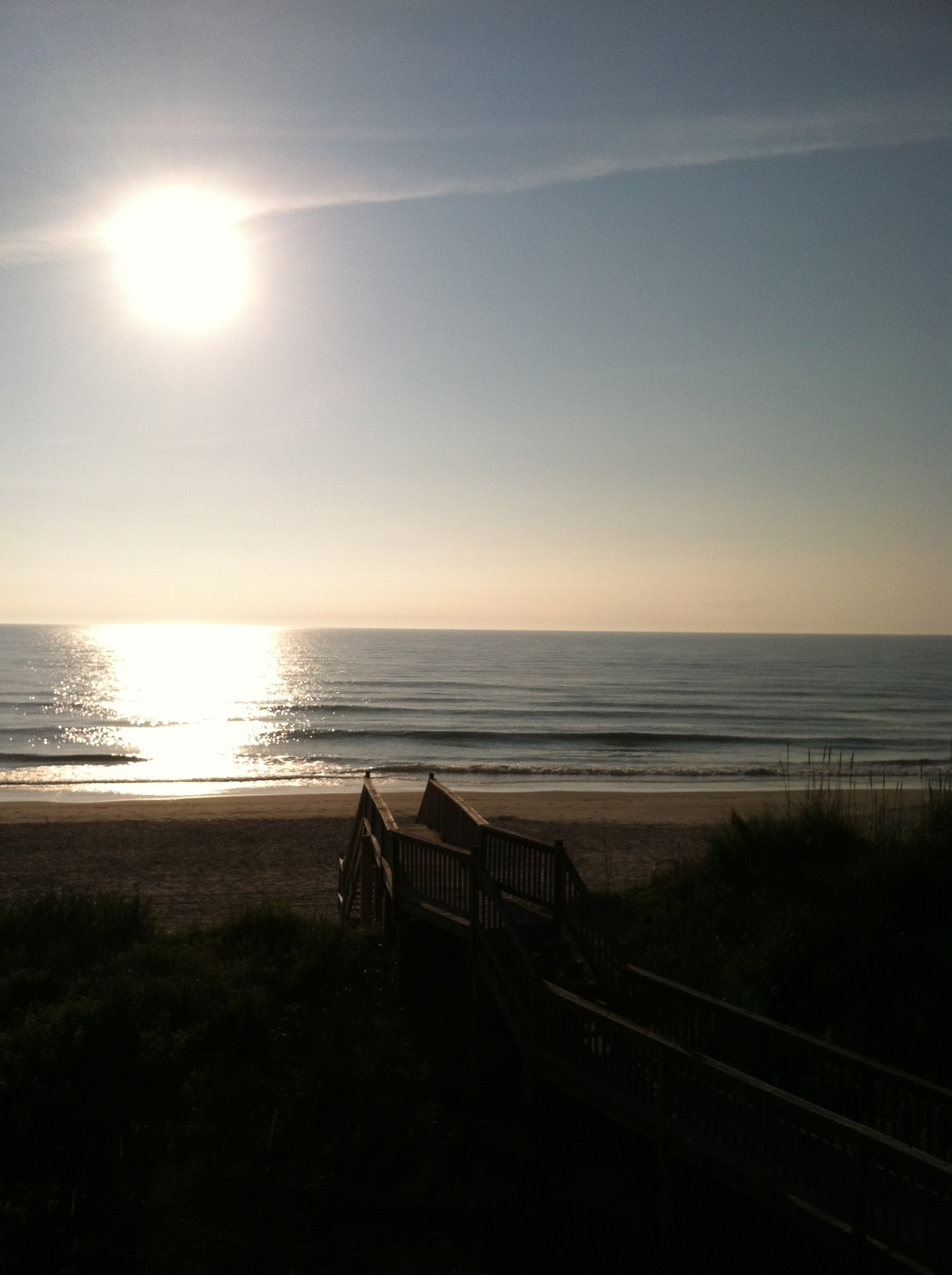
Every day for a week, I walked over this boardwalk onto the beach of Corolla, N.C., and into a kaleidoscope.
So a story about watching the sun rise over Corolla, N.C., on the Outer Banks, at about the most Eastern point of the mid-Atlantic coast of the United States. Not knowing when I would ever pass this way again, I made a promise to myself on vacation — a family reunion at a beachfront home to celebrate my Dad’s 80th birthday in the summer of 2014 — to get up while it was still dark.
The intent was to walk the beach, wait for the sun to break over the ocean’s horizon and see what the morning would bring. For five consecutive mornings from July 14-18, I watched a new day dawn over America.
Without coffee.
“That’s dangerous,” said my husband, Tom. “You want your family to know what you’re really like?”
“Are you crazy?” my sister-in-law Missy asked. “You’re on vacation!”
Indeed I was, but I’m old now — and menopausal, so sleep comes whenever it wants. And besides, there’s always the second greatest invention behind the glass of wine: the nap.
In those spectacular, early-morning hours on a beach in North Carolina, I learned a few things, among them:
Every sunrise, every day is different. Each day was like one of those kaleidoscopes you had as a kid, changing by minute not by my hands, but by God’s. Lesson learned: You think you’ve seen it all, but you haven’t.
Round and round she goes. We don’t feel the earth move beneath our feet, but it does. From the moment a glowing dot appeared on the ocean’s horizon, the movement of the sun was palpable as I literally watched it rise. Lesson learned: Don’t blink.
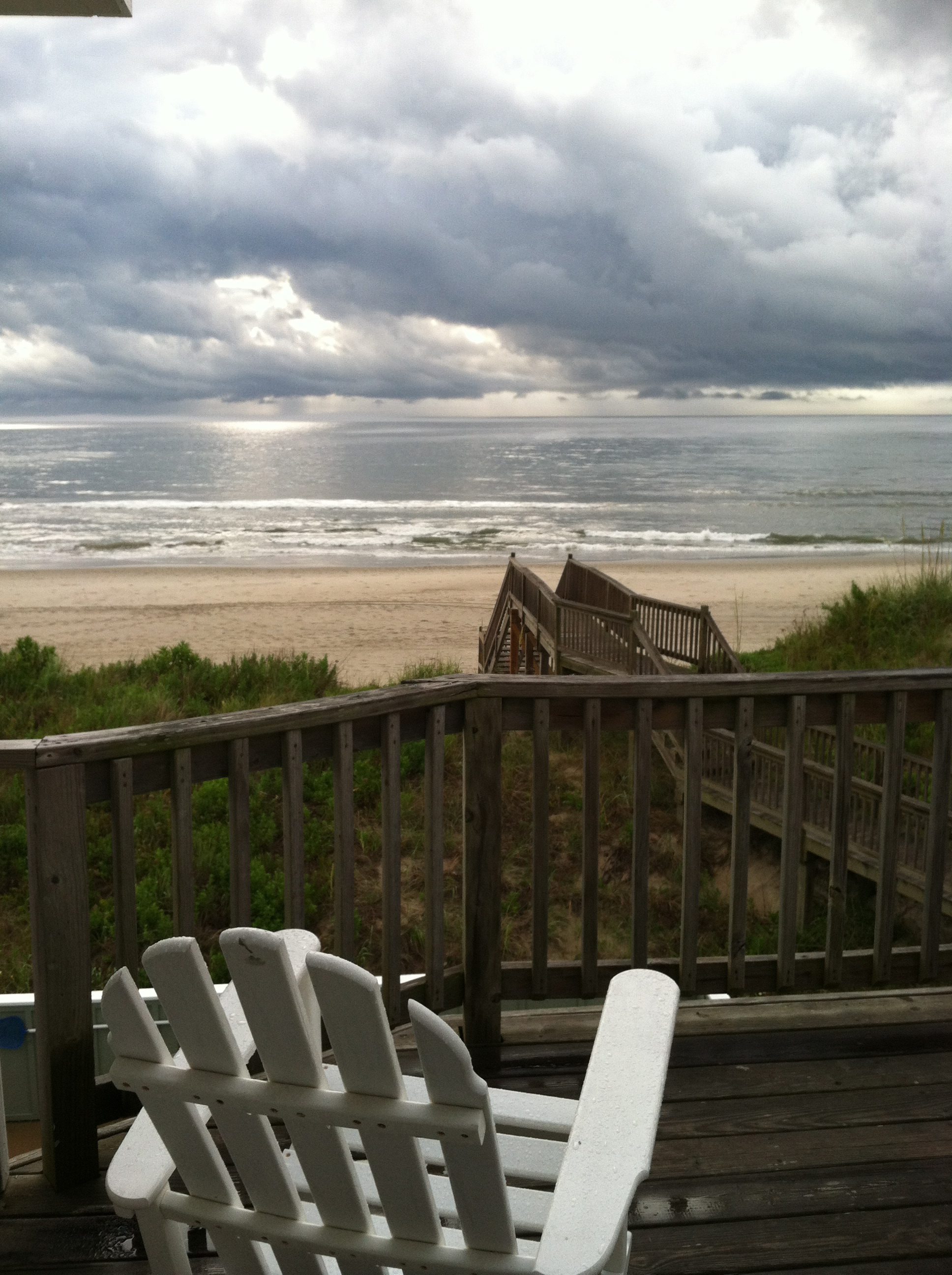
It all depends on your point of view. On Tuesday, a storm raged off the coast, what must have been a stormy ride for anyone sailing through it. Yet the sun still rose, and from where I stood its rays sprayed through the clouds like a silk hand fan. Lesson learned: Light always finds a way.
Rain? So what. The most vivid colors and most interesting images came the morning the Weather Channel claimed a washout. Lesson learned: More reliance on instinct, less worry about what computer radar says.
Each day is a fresh start. A sunrise promises each one of us a chance to start over, to begin anew. Each morning I walked up the boardwalk over the dunes back toward the house, knowing I’d be surrounded by the love of my family and Tom and my boys, and that was all that I needed.
That, and coffee.
It was among the best weeks of my life.
A version of this appeared in the Aug. 1, 2014 issue of the South County Times.
My great aunt, Florence Clifford, died peacefully Nov. 24, 2013, at age 99. She was the last of an entire generation and a true original. I’ve written a few columns about her over the years, and I had the privilege to say a few words about her remarkable life at her Memorial Mass at Holy Trinity Catholic Church on Jan. 18, 2014:
We are here today for the woman we all know as Aunt Florence, the last surviving member of a generation, the last surviving spouse of the five surviving children of Thomas and Mary Clifford.
John and Bert. Ed and Margaret. Bill and Helen. Rich and Leona. Hughie and Florence. Joe and Connie.
All gone now, yet all the reasons why we’re here today.
It’s our family: One big, crazy, over-achieving, slightly dysfunctional, fighting Irish Catholic family, and Florence, who married into this family and had no children of her own, loved every last one of us.
I am humbled to be speaking here today because I didn’t know her nearly as well as my aunt, Peggy Foley, or my cousin Judy Meyer or any of you nieces and nephews, or even my brother Mike Gibson, who I think most reminded her of Hughie. But since I know Mike and Peggy pretty well, I’ve gleamed onto stories over the years and there are some real facts we know about a life well-lived.
You can look up a lot on the Internet. One night recently, with a class of wine and a month-long subscription to Ancestry.com, I read two vastly different census records that shaped Florence in ways none of us probably ever knew.
In 1920, she is a 5-year-old living on Partridge Ave. with her father Thomas Carey, a 37-year-old pressman for a printing company; her mother Margaret, 33; Sisters Julia, 10, and Ellen 8; and younger brothers Thomas, 3 and James, an infant. A family. An intact nuclear family of whom a young Florence undoubtedly had fond memories.
By 1930, her address is Emerson Ave., living with nearly 140 other “inmates” at the St. Mary’s Female Orphan Asylum in Walnut Park, run by the Sisters of Charity.
The St. Mary’s Female Orphan Asylum in the Walnut Park neighborhood in St. Louis. Photo courtesy of Mark Abeln.
Her mother died suddenly, you see, and her father could not care for five children so the girls were sent to one institution, the boys another. How hard that must have been for a young child to lose not only her mother, but have her family unit ripped apart. A reminder that life could be cruel, but truly God has a hand in everything.
Documents don’t lie, and that 1930 Census entry for Florence Carey is four pages long, listing her age, 15 at the time, her status as an inmate and name after name after name of girls with whom she shared residence in a building that still stands in Walnut Park. Names such as Margaret Breheny, Helen Wisnewski, and Mary Aliperti. All girls around her same age. All girls she was probably very close to. All girls who endured hardships like Florence.
The document ends abruptly with these words: Here ends the enumeration of St. Mary’s Female Orphan Asylum.
That seemed harsh to me, but Florence lived a sobering reality, and one in which none of us have come close to experiencing. I think perhaps, though, God might have had a special interest in a childhood like that.
St. Mary’s was a place where Florence learned skills she would use the rest of her life: cooking, sewing, bookkeeping, and more importantly, perseverance, good humor and emotional strength.
When the time came for Florence to leave the home, she entered the convent for a year or so but discerned the religious life wasn’t her vocation, so she went to work a factory as a teenager. It’s those moments and years that we don’t really know about, those daily drudgeries and challenges of the 1930s Depression in St. Louis, Mo., that had to be difficult. But there’s a common thread: Perseverance.
And we know this: At some point in the late 1930s, Florence Carey would meet the love of her life, Hughie Clifford, the second youngest brother of five Irish boys of Benton Street.
Hughie, by the way, would be 102 today. January 18 is his birthday.
Florence continued to work, the two of them saving enough money so they could buy their own roof. That was extremely important to her – to have a place and a home she could call her own. They married in 1941, just in time for the start of another monumental challenge.
Put yourself in Florence’s place for a moment on Dec. 7, 1941.
A newlywed, looking forward to a first Christmas together, having surviving the childhood you did, working as hard as you had to get some security, finally finding happiness and love and then one December morning your world is shattered again. I can’t imagine what it was like to listen to news reports knowing that your 29-year-old husband was likely to be going off to war.
That’s exactly what happened.
Hughie was drafted and served with George Patton’s Third Army. The last thing he said to her before he went overseas: “Whatever happens, don’t lose the house.”
She didn’t. Florence became a real-life Rosie the Riveter, working a shift in a munitions factory and then going to work at the Downtown Famous-Bar later that day. When she got home each night, no matter how late it was, she’d write Hughie a letter, even though months would pass without word of his whereabouts. Letters were important – if she couldn’t get to him, the U.S. Mail would.
Hughie returned home in 1945 with every one of Florence’s letters. Imagine if we could read those letters today. Every last one of them would be a treasure.
They made a life together for the next 43 years, first in St. Louis, then in the Daytona Beach-area town of Port Orange, Fla., grounded in faith, bolstered by family. You know we all had an open invitation to visit anytime we wanted, and many of us did.
Hughie died in 1988. Florence went on, because that’s what she did. She persevered. She traveled, attended daily Mass, and organized things like food pantries and clothing drives for the poor at Epiphany Catholic Church, just a block away from their home and a place that became as important to her as her family.
There’s one last story I want to tell that I can remember vividly listening to, sitting at Judy’s kitchen table on what was likely one of her last visits back to St. Louis about 11-12 years ago.
My son, Matt, who’s now 19 and a sophomore at Marquette University, was about to make his First Communion, and Florence was extremely interested in the details of that event. It was an important Sacrament to her, the most important one of all, she said.
She told me how she remembered the priest instructing her class in preparation back at St. Mary’s, telling the children that on that particular day in which you first receive the Body of Christ, it is the one day of your mortal life in which you are closest to God.
So you should be prepared, Father told them, to pray for anything that day because it only happens once. Nuns, being nuns of course, went around afterward and suggested to each child what they should pray for and they told Florence that she should pray that her brother and sisters always stay together, always stay in touch.
They did. And then she married into another extended family, and we’re all still here, too.
There are so many more stories about this remarkable like of survival and perseverance, of looking at any situation with gentleness and humor and knowing that no matter what life throws at you, it’s going to be OK.
Faith and family. That’s really what one of the last surviving residents of the St. Mary’s Female Orphan Asylum was all about.
So if there are takeways from a life well lived for 99 years, it’s practice your faith and keep your family — your crazy, over-achieving, slightly dysfunctional, extended fighting Irish Catholic family, as close as you can.
This appeared in the South County Times Aug. 16, 2013. My word count is pretty strict — which is a good thing at times because it forces you to write tight. But here it is again as I would have written it had there been no constraints:
It’s only natural I would have the dress. I am her only daughter, and, while I don’t remember it growing up, somehow my mother’s silk wedding gown with the arm-length lace bodice ended up in my basement.
The dress made its debut Feb. 7, 1959, when Betty Clifford married Les Gibson at St. Liborius Catholic Church in their north St. Louis neighborhood. That wedding day would be its one and only appearance, loosely folded and stuffed afterward into a clear plastic bag in anticipation of a dry cleaning it never received.
And in that bag it stayed through 35 years of a life together, raising a family until Betty’s untimely death at age 55 from leukemia. A few years after that, it got moved to my basement along with china, pictures and other knick-knacks that has come to be known as My Mom’s Stuff.
I have a lot of My Mom’s Stuff. Nineteen years gone, her presence still looms large in my family – not in a debilitating, grief-stricken way, but more of an uplifting warmth that manifests itself when least expected, as in finding a sand dollar on a beach or a rainbow at the bottom of a waterfall.
And so shortly after the engagement of my nephew Dan Gibson, her oldest of nine grandchildren (of which she would know only Danny and his brother Nick), it occurred to me that maybe it was time to get that dress off the shelf.
If only I’d gotten her sewing gene. I spent months Googling “new uses for old dresses” and “wedding dress makeover” and other such phrases, getting ideas but never feeling confident to send the dress to an unknown entity. Until my husband Tom said, “Lucy can do that.”
Lucy is the proprietor of Lucy’s Dressmaking & Alterations on Hampton Ave. in south St. Louis. She’s been mending for Tom for years, and saved me from years of sewing Boy Scout merit badges. I had never met Lucy until the day I walked in her shop with the dress in the bag and said, “Here.”
I needed a ring bearer pillow, I told her, but what was left unsaid was that I wanted so much more. I wanted something old made into something new; something sorrowed into something true. Not just for one grandchild’s wedding. Eventually, I would need nine of something from this dress and I wanted what material she didn’t use back.
Can you help me? Lucy nodded, and said, “I can do that.”
Two weeks later, I held in my hand a ring bearer’s pillow, made out of silk, covered in lace. It took my breath away. She returned the dress, too, in the same bag in whichI handed it to her.
Last Saturday, Dan married the lovely Jess Reeder of Paducah, Ky., on the campus of the University of Evansville, where they met seven years earlier. Among the members of the wedding party: his youngest cousin Zachary Gibson, ring bearer, carrying a pillow made from a dress, covered in lace, straight from heaven.
OK, so I’m 50. Now what? Here’s a list of 28 things I still want to do, from Broadway to Blarney Castle; Mint Juleps to Mackinac Island. Why 28? Averaging one per year, I think I might need to rest when I’m 78.
Climb a mountain, any mountain and throw my arms up in the air in triumph at the summit.
See Niagara Falls and fight the urge to quote the 3 Stooges while I’m there.
Get a Library of Congress ISBN number under my name.
Dance with Tom on our 25th — and 50th — Wedding Anniversary to When Irish Eyes Are Smiling, the first dance song at our wedding.
See a show on Broadway in New York City, preferably Les Miserables but Wicked will do.
Watch a baseball game with writer/historian Doris Kearns Goodwin and discuss her great baseball book Wait ‘Til Next Year.
Shake hands with the President of the United States, doesn’t matter which one.
Wear a designer dress to a black-tie, formal affair.
Dance at my sons’ weddings, to anything BUT The Harlem Shake or Gangnam Style.
With Tom and my boys, climb to the top of Blarney Castle, the ancestral home of the McCarthy clan.
Feel the beat of a grandchild’s heart against mine.
Go to Mass at St. Patricks Cathedral celebrated by the Archbishop of New York.
See Matt graduate college
See Jack graduate college.
See Paris from the top of the Eiffel Tower.
Take a hot air balloon ride.
Venture out on that skywalk thing over the Grand Canyon.
Walk across the Golden Gate Bridge (can you do that?)
See Jimmy Buffett in concert.
Drive the Going to the Sun Road into Glacier National Park.
Visit the Baseball Hall of Fame and have my picture taken next to Ozzie Smith’s plaque since I voted him in
Have a drink at a bar in Key West, Fla.
Stay at the Broadmoor Hotel in Colorado Springs.
Attend a wine tasting with a world class sommelier.
Drink a Mint Julep at the Kentucky Derby, funny hat optional.
Get my picture taken with the Stanley Cup (preferably because the Blues have won it).
Sit on the front porch of the Grand Hotel on Mackinac Island.
Walk the Freedom Trail in Boston, Mass.
Just for fun, I’m throwing in five things I hope I never do:
Read an entire book on a Kindle or electronic device.
Crown Candy Kitchen was as much a part of my childhood at The Brady Bunch and playing CYC softball. My grandmother lived a block away, in the same Old North St. Louis flat on Montgomery St. in which my mother, her daughter-in-law, grew up.
So a day-visit to Grandma’s always included a malt at Crown’s. It’s iconic in St. Louis now, made famous by cable food shows and travel blogs as an authentic malt shop that looks the same as it did in the 1950s. It is a step back to a simpler place and time, with sandwiches, homemade candy and frozen confections that make your mouth water. Crown Candy is famous for its soda fountain and homemade ice cream, but it is its BLT’s that have given it its latest claim to fame.
So it was no surprise my younger brother Jeff put out an email one recent Friday morning for anyone and everyone in the family to meet him for lunch, and a few of us did.
Fourteen pieces of bacon allegedly make up Crown Candy’s BLT – give or take a few morsels. And Jeff was about to put it away – along with a 24-ounce chocolate malt served up in its aluminum-mixing container.
Jeff was passing through town en route from Kansas City to his Virginia home. He had arrived the night before – via kayak.
Eleven hours earlier just after midnight Aug. 3, Jeff had paddled into the St. Charles riverfront at the finish of the MR340, a grueling three-day race on the Missouri River.
In its seventh year, the MR340 is the world’s longest nonstop river race and was recently dubbed one of National Geographic’s Top 40 adventures. It starts on the Missouri River just west of Kansas City (right, taken from Jeff’s kayak). Participants – this year 294 entries of solo, tandem and team kayaks – had to finish within 88 hours; Jeff finished in 65 hours, 27 minutes. He was 18th in the men’s solo division and one of 186 to finish.
He earned that BLT.
This year’s race was his second go-round touring Missouri via Kruger Seawind kayak. As we sat in the booth at Crown Candy, all I could ask was why?
“For the challenge,” he said, eating bacon. “To stave off becoming a fat, balding, middle-aged defense contractor.”
Jeff isn’t your average little brother. He’s a Navy SEAL veteran who undoubtedly has had more adventure than National Geographic will ever put in its pages. But he’s a regular guy, and, if you asked his only sister, I would say balding, middle-aged defense contractor about covers it. Fat? I’d never say that. He’s my little brother, but he can still punch me.
But Jeff makes things look effortless and always has. Despite needing a shave, he looked none the worse for wear after spending three 100-plus-degree days in a kayak on about two-and-a-half hours of sleep total, catching a nap here and there at a couple of the nine checkpoints.
“This was 100-times harder than last time,” he said, having also done the race in 2009. “There was just no current, and the heat. I had memories of Hell Week.”
Hell Week? That was 20 years ago and thankfully, we had no idea what he was doing. This time, thanks to modern technology, family and friends were able to track him every 10 minutes on the river, including his 10-year-old daughter Mia, who was tracking her dad from Chesapeake, Va., and showing her mom Karen and little sister Katerina how to do it.
We used the technology; he didn’t. The Missouri, he says, is pretty remote. Other than Jefferson City, it meanders through the state past small towns and parks, and for the most part is a pristine, remote wilderness. He passed the time with books on tape and enjoyed the solitude. When he got hot, he says he filled his hat with ice from the cooler he kept behind him and placed it on his head until it melted — and then he’d do it all over again.
He says, he thinks this year’s MR340 will go down in history as the hardest one ever, but he has no regrets.
“The best thing about it was three days of no computers, cell phones, texts or emails,” he says, “and I met some great people.”
The support team
Jeff (center right) didn’t do it alone. Some entries in the race had elaborate support teams following kayaks with plenty of provisions and detailed precision. Jeff had our older brother Rick (second from right), a lawyer who took a week off to follow his younger brother around the state of Missouri.
“The first day I had him bring me healthy stuff — protein bars and gel and bananas,” Jeff said. “By the second day all I wanted was junk food.”
Rick showed up with ham sandwiches, Fritos and Snickers bars the second day and Jeff was grateful. At Checkpoint 8, the last checkpoint near Weldon Spring, Mo., Rick was late because he was searching for a White Castle. Thankfully, the MR340 organizers had food available and Rick showed up in time to restock provisions for that last push.
“Hey, what about the hardships I endured?” Rick says. “A lot of those small towns didn’t stock Bud Select. I had to drink Bud Light.”
Rick was at Crown’s too, also eating one of those famous BLT’s. He did a great job of informing the family of Jeff’s progress through emails and texts. He is kicking around the idea of doing it next year, as is my husband, Tom, but there would have to be a significant amount of training as neither of them were Navy SEALs in a previous life.
I asked Jeff, who at the time was less than 12 hours removed from pulling out the kayak on the St. Charles riverfront, if he would do it again.