My mom, Betty Gibson, in front of our Estes Drive home in Florissant, circa 1962, with my older brothers Mike (left), 1, and Rick, 2.
One day in 1958, a young, engaged couple went looking for a house. They took a Sunday drive, heading about 15 miles northwest of their St. Louis neighborhood, Montgomery Street on the near north side, to a town called Florissant.
What was not to like about the Valley of Flowers? Florissant was an up-and-coming, affordable suburb. Highways were being built. A couple could have their own life but stay close to the city. For two Depression-era babies looking to build a family, Florissant represented the future.
And so they may have picked up a newspaper to plot their day. They may have seen an ad for a subdivision called Brinwood touting affordable housing with little money down. They may have read about an advertorial touting the “no through-traffic main streets.” They may have circled “shopping districts” and “good schools and churches.” And they probably read right over “Coldwater Creek sewer district.”
These are the keywords here: Coldwater Creek. Perhaps you’ve heard of this tributary of the Missouri River that starts near the airport and meanders through north St. Louis County. It’s getting national attention because of a new HBO documentary called “Atomic Homefront.”
If you think this is a North County story, it’s not. The film depicts St. Louis’ little known nuclear past as the uranium-processing center for the Manhattan Project, and how nuclear waste found its way into the soil and groundwater. The story is riveting and complicated, and connects the dots that now affect two St. Louis communities: Bridgeton, adjacent to the West Lake Landfill, and the neighborhoods nestled along the creek — a neighborhood in which our young couple found their starter home.
They closed on their ranch on Feb. 5, 1959, two days before they married at St. Liborius Catholic Church. In the next 7 years, they’d have four kids — a boy in 1960, a boy in ’61, a girl in ’63 and another boy in ’66. I was that girl.
Betty in her backyard garden on Estes Drive, circa 1992.
Our neighborhood was idyllic. My older brothers Rick and Mike, and my younger brother Jeff and I played outside with the neighborhood kids constantly when we could, just needing to be home when the street lights came on. The Schultes, the Scharfs, the Sheltons, the Gartens, the Axleys, the Barnetts … every house had a mom with a set of eyes, so if you did something wrong you likely got in trouble twice.
And one block over flowed a tiny Coldwater Creek tributary, a part of that subdivision sewer district. “We must have played in that creek over a hundred times,” my younger brother Jeff said.
Over the years, when neighbors died of cancer, we figured it was one of those things. When it’s your own mom, well, that’s a stroke of personal bad luck. Betty Gibson lived on Estes Drive for 35 years, from her wedding day in 1959 until she died of leukemia at age 55 — exactly 24 years ago March 3. The missed years add up, and with every new grandchild, every milestone, every holiday, every large, grand family vacation, the missing piece looms large.
But you play the hand you’re dealt, because cancer can be so random. Until one day, you discover that maybe it wasn’t.
A shorter version, “Atomic Neighborhood,” was originally published March 2, 2018, in The South County Times.
An ad in the classified section of the St. Louis Post-Dispatch from 1959.
It’s on the record that on June 25, 2017, the Class AAA Toledo Mud Hens lost 4-1 to the Class AAA Columbus Clippers, a fact little noted around these parts unless you happen to be an avid fan of their Major League Baseball parent clubs, the Detroit Tigers or Cleveland Indians.
Thomas E. Clifford, 1896
But while the Mud Hens were playing 430 miles away in Ohio, about 60 descendants of one of their former players were gathering in Crestwood’s Whitecliff Park, south of St. Louis, for a reunion. Funny, crazy Irish people — my people — gathered at Pavilion No. 3, and it was glorious.
That the pavilion lies across the parking lot from a pristine baseball field was no accident because of this: A record on www.baseballreference.com for one Tom Clifford, who played professionally for five seasons from 1895-1900 in places such as Shreveport, La., Paducah, Ken., Peoria, Ill., and Toledo, Ohio.
In between attempting a professional baseball career, the son of Irish immigrants learned how to be a grain inspector and met and married in 1899 a woman named Mary Kennedy. After that, children — eight of them from 1900-1915, seven boys, Thomas, John, Edward, William, Richard, Hugh and Joseph, and one girl, who died in early childhood.
The official baseball record stops in 1900 after the birth of the first child, a boy also named Thomas. Apparently, family won out. Either that, or the reality of a .225 career batting average, probably due to the fact he couldn’t hit a curveball. (It’s always the curveball’s fault.) But at least Tom Clifford gave it a shot, leaving baseball behind in his DNA for what is now five generations.
Twelve of the 14 surviving grandchildren of Thomas Clifford at Whitecliff Park in Crestwood, Mo., June 25, 2017.
Six of Tom and Mary’s eight children survived into adulthood. The boy Thomas, family legend has it, drowned in the Mississippi River on the day of his First Communion. Of the six remaining boys, four would produce among them 15 children, 14 of whom are still with us. It was the children and grandchildren of those 15 who gathered wearing t-shirts in colors distinguishing the four families. The “Eds” wore red, the “Bills” wore green, the “Riches” wore yellow and the “Joes” wore blue, a regular rainbow coalition.
Isn’t that what family is? A mixture of young and old, near and far, colorful and quirky. The oldest, Patty Reckamp, is in her 80s; the youngest were in their 1s. Relatives came from Atlanta, Ga., Chesapeake Va., and from just down the road. The weather couldn’t have been more perfect, nor could the company.
It’s a roll of the dice whenever extended family gets together. But nobody got into any fights nor offered a cold shoulder. People were genuinely happy to be in each other’s company, if only for a short while. Why? Family is what grounds you. It’s good to be reminded of who you are and where you come from before you can figure out where to go next.
If Tom Clifford could have hit the curveball, imagine how different the family might have been. But he couldn’t, and here we were five generations later, still together in the shadow of our own Field of Dreams.
Tom Clifford was an original Mud Hen, quite possibly a reason the picture above exists. For it was in 1896, according to the Toledo club website, that the professional “base ball” team adopted the moniker that would become one of the most unique minor league nicknames in baseball history. Among the club’s most noted alumni are Jim Thorpe, Kirby Puckett, Curtis Granderson and Brandon Inge (Cardinal fans will remember him as the final strikeout at the hands of Adam Wainwright in the 2006 World Series.)
The record referenced above has Tom Clifford playing five seasons throughout the Midwest. Yet there may have been more. His Dec. 20, 1940, obituary in the St. Louis Star Times, written because at the time of his death he was an elected official — constable of the Seventh District — adds more: a managerial stint in New Orleans and a final attempt with the St. Louis Browns in 1904. I’m still working on verifying those details. But that doesn’t take away the thrill of seeing a name in a box score or in the text of a story pictured from an 1896 clipping in the Fort Wayne Gazette titled, “Wonderful.” It’s an account of a game between the Mud Hens and the Fort Wayne Farmers and is must-read not only for the prose, but for the details of the umpiring. You think journalism is biased today? Read it.
And then there’s this: A single line on the bottom row of a 1900 census book, the Twelfth Census of the United States. Amid information about Thomas E. Clifford’s birth (May 1875); birthplace of his parents (Ireland, in both cases); and his status in the household (head) on O’Fallon Street in the 16th Ward in north St. Louis is a column marked “occupation.” There, it says simply, “ball-player.”
The box score is superimposed and highlighted from the article in the second column of the July 1, 1896 Fort Wayne Gazette.
Baseball is clearly in the DNA. Here’s a picture of a baseball team, circa 1920s, with two of Tom’s sons, my maternal grandfather Bill Clifford (kneeling third from left) and his younger brother Rich Clifford (third from right):
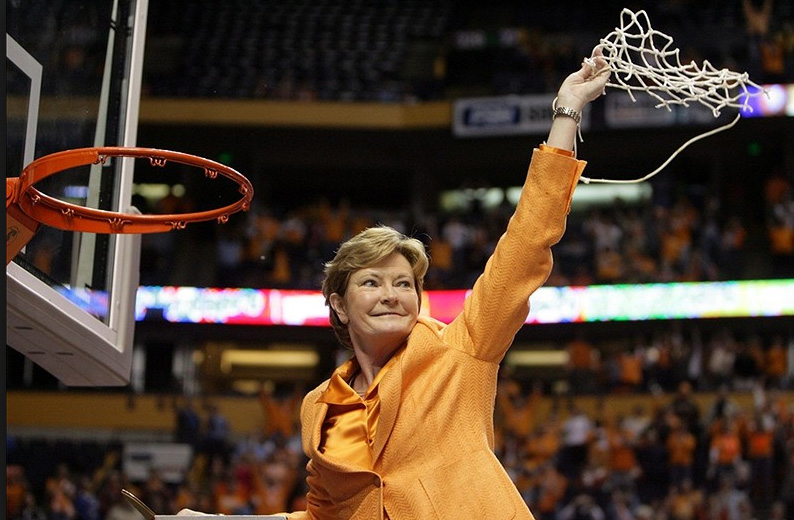
In the 1990s, I was privileged to have a front-row seat to a legend, covering Pat Summitt and a few of Tennessee’s national title games for the Sporting News. I learned more about her and her coaching style witnessing the loss than in the victory the next year. Here’s a remembrance I wrote for the South County Times after Summitt won her 1,000th game:
A brush with a legend
FEB. 13, 2009 (SOUTH COUNTY TIMES)- It went unnoticed last week, a sports milestone lost in news of steroids and stimulus packages.
But not here. University of Tennessee women’s basketball coach Pat Summitt won her 1,000th game Feb. 5, making her the winningest college basketball coach of all time. Summitt, 56, has been coaching since 1974. In 35 years, she has 1,000 wins and 187 losses — she wins 84 percent of the time she leads a team onto the court.
If you’re a Vols fan, you’re cueing up that cute “Rocky Top” song. I prefer something from Helen Reddy, because never was there a case for “I Am Woman” girl power as this one.
I have a Pat Summitt story, having had the privilege to meet her on a few occasions, the first in 1995 when Tennessee was in the Women’s Final Four.
That April, I was at the Target Center in Minneapolis for the women’s national championship game between Tennessee and the University of Connecticut, seated in the first press row directly behind the Lady Vols bench. It was like having a front-row seat to every motivational informational seminar known to man – or woman. Pure, unadulterated passion mixed in spirit and intensity. And I had a 40-minute survey.
At one point near the end of a back-and-forth game, Summitt took out one of her starters and sat her on the bench. In the midst of the frenzy of about 23,000 screaming fans, she squatted down to eye level and with passion, intensity and a screaming southern drawl said, “This is the biggest game of your life. If you let it pass knowin’ ya didn’t give it your all, how ya gonna feel? How ya gonna FEEL?”
So there it was, the pinnacle of college basketball, and the coach was not just talking strategy, she was talking FEELINGS.
Therein lies the difference between a man and a woman. A man may, in the heat of a battle, tell you to go to h-e-double-hockey-sticks. A woman will tell you the same thing, but worry about how you’re going to feel making the trip.
I loved that moment.
Tennessee lost the game, UConn won the title. But I learned an indelible lesson that night: Never let any moment pass without giving it your inspirational, perspirational, 110-percent all.
A postscript:
I covered the women’s game for TSN for the better part of the 1990s, and somewhere along the line got a handwritten note from Pat Summitt thanking me for taking the time to promote women’s basketball in a national magazine. I was flabbergasted that she would write someone she met in passing a few times.
It’s tucked away in a box somewhere. I don’t know precisely what it said, but I remember exactly how it made me FEEL.
With those words, uttered four years ago this spring, it was settled. Matt McCarthy was committing to the university we almost overlooked, the place we almost didn’t visit, the school that, in my mind, was … good enough.
Good enough? Stay with me here.
The spring of his senior year was an emotional time in our suburban St. Louis household — just as it is in every household in America where an 18-year-old sleeps. It’s senior spring and all that goes with it: final classes and AP exam prep, proms, senior activities, spring sports. And his dream school — indeed, our dream school for him, one of those “elite” universities with acceptance rates in the teens — had just pitched him one of the cruelest curve-balls an institution can throw: The waitlist.
A waitlist is college admissions limbo at the worst possible time. It’s a letter that arrives, often late in the spring, that tells young people they’re qualified for admission, but not good enough on the first pass. But hang on, because there might be a spot before classes begin in the fall.
Not good enough? How could that be? As his mom, I was dumbfounded, and took it personally. Throughout Matt’s high school years, everything pointed to a positive outcome at that dream school. Every varsity letter, every “A”, every AP score; every hour in ACT prep class; every merit badge that helped him achieve Eagle Scout. How could this school – I don’t need to name it, but it’s south and east of Milwaukee, and around Lake Michigan’s bend — not accept him outright?
Turns out, Matt at 18 was much smarter than his mom at 49. He wanted no part of the waiting game. He wanted to move on with his life. The day after receiving the letter, he said, simply, quietly: I’m going to Marquette.
And so it was settled. Just like that.
Marquette? Yes Marquette. Thank God, Marquette.
You see, what I forgot that spring four years ago was that it wasn’t my life that was at stake, and anything that happened in the college admissions process wasn’t personal. If there’s one lesson that should be shouted from the rooftops to every parent of a kid going through, or about to go through, the high school years, it is this:
Don’t think your son or daughter needs to go to what a guidebook or an arbitrary ranking says is the best school. Find the best school for your son or daughter.
You do that by visiting campuses. By asking questions – lots of questions. By getting a feel for the culture, the academics, the campus life. All of it. And you hope — and pray — that it works out. It’s that simple.
For us, that place was Marquette University. Where we got lucky, I know now, is that we didn’t find Marquette. Marquette found us.
An interrupted campus tour
In the summer of 2011, our family of four took an upper Midwest college tour with Matt and our younger son, Jack. Both boys were students at St. Louis University High School, Matt, a rising senior, and Jack, an incoming freshman.
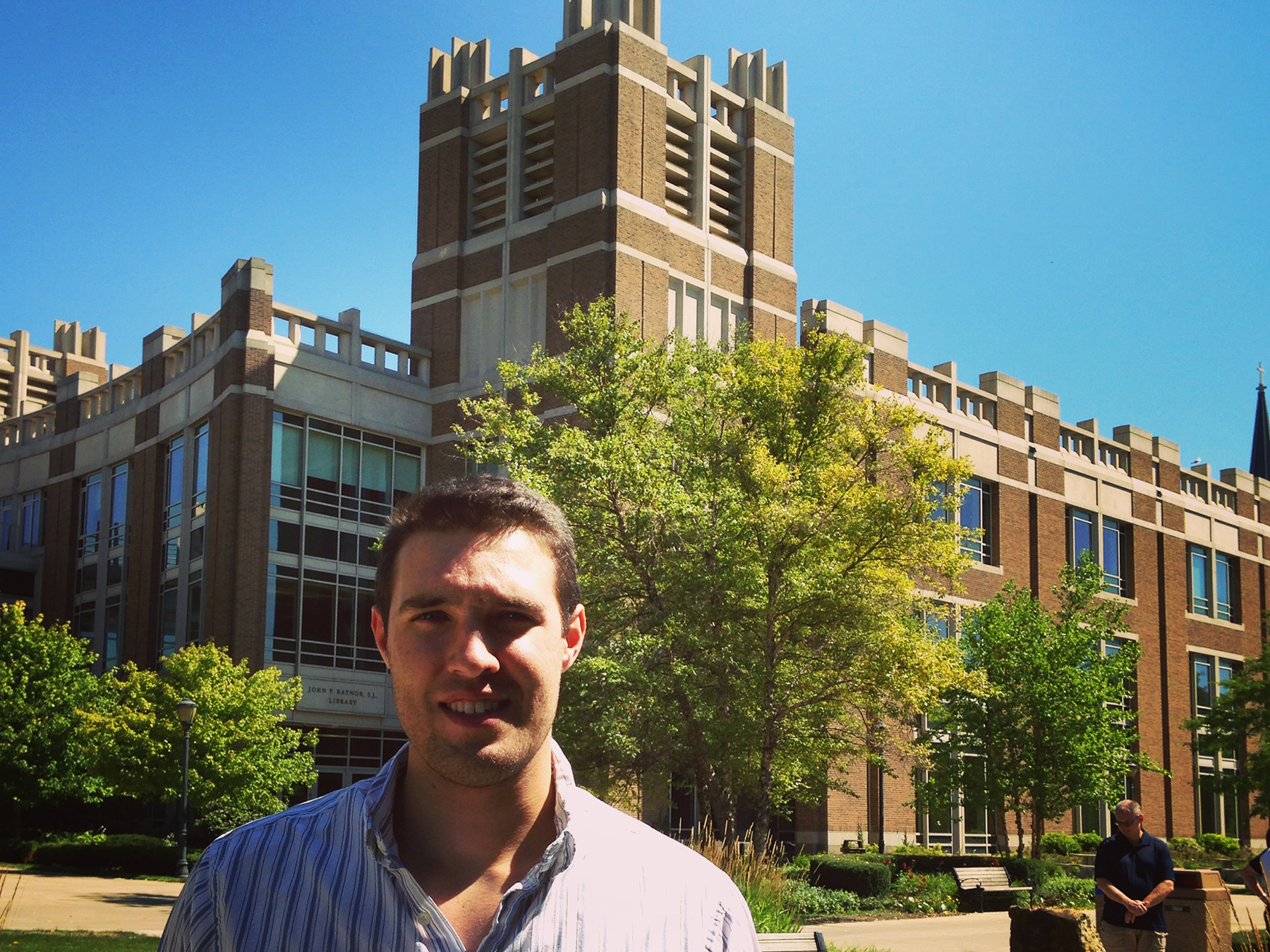
Matt’s first day at Marquette, August 2012.
It was timed with precision. Four days, four colleges. We started in South Bend, Ind., and then made two stops in Chicago with a fourth planned for Milwaukee to visit Marquette U.
But by the third day, we had had enough admissions-speak. Three days of happy faces and snappy videos; three days of gushing, squeaky-clean tour guides. It would have been easy to head south on Lake Shore Drive and home to St. Louis. Instead, we stayed the course.
And sure enough, upon arrival in the Admissions Office in Zilber Hall on Wisconsin Ave., we watched a snappy video featuring comedian and alum Danny Pudi, and went on a tour with a delightful young woman from St. Louis, who had a brother who was a graduate of the same high school as our boys.
By that point, it was hard to distinguish one university from the next. Marquette was nice, to be sure. But this moment changed everything:
We were standing in the Alumni Memorial Union when seemingly out of nowhere, an elderly priest came rolling along on a motorized wheelchair, greeting us with such joy that it felt as if a wave had overtaken us.
Sophomore year, August 2013.
The tour guide smiled and took a step back in deference to Fr. John Naus, SJ, who began asking questions of all of us. When he found out we were from St. Louis and that my husband, Tom McCarthy, taught history at the Jesuit St. Louis University High, he regaled tales of his visits to the province and Jesuits they both knew.
And then he said to all of us, “Follow me.”
We followed him down the hallway to an office, where, for another half-hour, he talked to us as if we were long lost friends. He told corny jokes and did magic tricks. But mostly, he gave his attention to Matt and Jack, making them feel as if he had been waiting on them all along. All the time, our tour guide waited nearby, patiently smiling.
When we continued on, she told us, “I’ve been stopped by Fr. Naus on campus tours a lot of times, but this is the first time I’ve been invited to his office.”
At that moment, we were 13 months away from saying goodbye to our son on a Wisconsin Ave., sidewalk. But all I knew then was that this priest came wheeling along on his motorized chair, and made all of us feel for 30 minutes like we were the most important people in Milwaukee that day.
At that moment, Marquette was inevitable.
Ringing out Ahoya
First day of junior year, 2014.
Fr. Naus would retire before Matt started classes in 2012. He died in September of 2013, Matt’s sophomore year. Matt may well be one of the few graduating seniors of the Class of 2016 with a link – brief but unforgettable — to the legendary Jesuit who said, “See written on the face of everyone you meet, ‘Make me feel important.’ ”
And perhaps, in a way, Fr. Naus passed on to him that afternoon some Marquette magic that lingered his entire four years. I’d like to think so.
By September 2013, Matt was a declared political science and history major; was settled into Schroeder Hall after freshman year in O’Donnell; and was beginning the activities that would mark his four years: Kappa Sigma fraternity, O-Staff; Wednesday night bingo caller in the Alumni Union.
Before the four years would end, he’d be a mainstay at basketball games, he’d be a regular coffee drinker at Brew Bayou and he’d be among the first residents to live in the Kappa Sig house, a renovated Masonic temple on 11th Street. He’d “Walk a Mile In Her Shoes” and take part in two Marquette Mardi Gras trips to New Orleans’ 9th Ward. He’d become president of his fraternity. He’d promote Senior Challenge. He’d attend 10 p.m. Sunday Masses in the Union. He’d Ring Out Ahoya through and through.
And I don’t even know the half of it. I’m just his mom who caught glimpses from 376 miles away in regular texts, weekly phone calls, and what little Facebook stalking and Snapchat stories I could decipher. And that’s how it should be. Marquette was his experience, not his dad’s and mine.
Just before the start of senior year, 2015.
And this month, sometime before the commencement ceremony, I’ll stand in the center of Wisconsin Ave., and take Matt’s picture in his cap and gown under the gate one last time, so I can have one to match the four I have from the beginning of each school year. We’ll attend the ceremony and I’ll cry unabashedly. But not before a fleeting thought for the school that waitlisted him. Not out of a grudge, but with great affection, because of this moment:
It’s the summer of 2010, the night before a football camp he begged us to send him to.
That night we arrived, we took our own tour of campus and stopped at one of its iconic corners, a beautiful grotto honoring the Blessed Mother. At that point, he’s a 16-year-old boy who only knows this campus is his dream, mostly because of a Hollywood movie and a pretty famous football team.
But we both pause to light a candle and kneel down, a mother and son in silent prayer. I got up first; he stayed kneeling for much longer than you’d expect of a 16-year-old.
I left him to it. After a few minutes he got up and asked, “So Mom, what’d you pray for?”
I wasn’t going to lie.
“I prayed that for whatever path you were meant to be on, God would make it clear – and possible,” I said.
“Mom!” he scolded me. “You always said, ‘Be specific’ when you pray.”
“I’m pretty sure I was,” I said.
Six years later, I know I was. And I know that prayer was answered.
A postscript
I did cry unabashedly that weekend, but not at the ceremony. I think it was on the way home that Sunday night, somewhere along I-43 in rural Wisconsin after picking up a case of Spotted Cow for Matt’s graduation party. Memo to future parents: Graduation weekend is a marathon, not a sprint. It’s a rollercoaster of emotion wrapped in a frenzy of parties and packing, pomp and circumstance, hellos and goodbyes. And that’s exactly as it should be.
Matt picked up degrees in political science and history that glorious weekend. Three months later, we packed up the car again and helped moved him into a studio apartment in Ann Arbor, Mich., where he began law school at the University of Michigan. He’s on his way. I am absolutely sure Marquette University had a lot to do with it. Turns out, that waitlist was the answered prayer.
A diminutive writer from Monroeville, Ala., died in February at 89, sparking a social media flood of tributes because of one unforgettable book and the timeless message it conveys.
Among the remembrances of Miss Harper Lee was a YouTube video from Notre Dame’s 2007 commencement. The university was giving her one of its honorary degrees, calling Lee “a national literary treasure whose work has left an indelible imprint on the American psyche with its themes of justice, tolerance and courage.”
Upon stepping to the podium to receive the degree, Lee looks out over the audience to see thousands of young men and women in academic garb holding up a copy of “To Kill A Mockingbird.” The gesture is genuine; her reaction is priceless.
“Her Pulitzer Prize-winning novel,” the proclamation said, “was a testament to the power of one person … who introduced us to some of the most poignant, most human characters in contemporary fiction. They, and she, taught us that we are more alike than different. That in the words of her heroine, young Scout, ‘There’s just one kind of folks. Folks.’ ”
The power of one person. How true that can be.
Two days later, a beautiful Sunday afternoon, a walk in the park with a friend.
The weather was gorgeous, and the park was coming alive with families on the playground and neighbors on the pathways — including one elderly woman I came to know regularly last fall.
She stood out because she wasn’t your typical South County walker: No lycra or GoreTex, no earbuds, no cell phone. She appeared always to be simply an old woman out for a walk, dressed plainly in a blue or gray dress with tights and a scarf.
Around the paths she saunters, sometimes with her hands behind her back, as if she’s relishing every visit, every breath of fresh air. And the best part: she always smiles and waves.
I always wave back. One day, I tried to start a conversation. “No Anglisht,” she said, but offered her hand. Another time, I asked her where she was from and she said “Albania, Albania,” with sparkling eyes and a smile.
I missed that in the winter months. I didn’t see her again until Sunday with my friend, Anne, another park regular who also had experienced the friendliness of this Albanian woman. We hurried to catch up to her, checking our iPhones for the word “hello” in Albanian.
“Pershendetje!” Anne yelled as we approached. “Are we saying that right?”
She turned around and smiled – chuckling at Anne’s Albanian, and offered her hand. “Hello, hello!” she said laughing, and walked on.
It made all of our days, this Sunday in the park. A simple hello, a warm handshake.
“There’s just one kind of folks,” Scout says in Harper Lee’s novel. “Folks.”
One Friday morning late last fall, I spent the better part of an hour online trying to buy tickets to the coolest entertainment event in St. Louis in 2016: The March 6 Bruce Springsteen concert. Must have hit the refresh button on Ticketmaster a hundred times but never got close.
Disappointed? Sure. It would have been a blast, and Tom would have gotten an awesome Christmas present. But sometimes, one day’s disappointment turns into another day’s delight.
The walk to the conference center each day.
Had we been successful in procuring Springsteen tickets, I would have said no when my boss came in my office one day in early February and asked this: “Is your schedule clear the first weekend in March? There’s this conference we want you to go to …”
And so last Thursday, March 3, my alarm went off at 2:30 a.m. to begin a 12-hour journey by cab, two planes, and shuttle bus – 1,748 miles from Crestwood – to a small town nestled in a Canadian national park. What followed was 90 hours in Banff, Alberta. Glory days? Indeed.
The conference was on storytelling in the digital age, a flood of technical information with one common thread: A good story is a good story, and it doesn’t matter if it gets told with paper and pen, a bunch of HTML code, or through the lens of a camera. And if gets told with collaboration among your colleagues, your friends, your families – all the better.
That was the work side of it. What I didn’t expect was the personal side. Something happens when you spend a long weekend out of your comfort zone in the Canadian Rockies – arguably North America’s most beautiful landscape – with a group of Canadian filmmakers and hipsters.
You see things through a different lens, both literally and figuratively. Where moviemaking and entertainment is going is extraordinary – think 3D experiences that don’t give you a headache and television sports that will project on your living room coffee table.
You breathe a lot of really fresh, crisp mountain air that cleanses your nasal passages and clears your head. You wake up four mornings to a maple-leaf mountain majesty that’s unlike anything you’ve ever seen. You eat bison burgers and drink a few beers with names such as Moosehead and Molson. You meet a lot of really nice people from all over the world, and no one seems to care that sitting in the restaurant are folks of many different nationalities and race. And you hear stories, which is fundamental to each of us.
I ran across a quote once that said, “Make each day a story worth telling.” So if today you don’t get those concert tickets or that promotion; if you miss the bus or your car breaks down, if the day seems unbearable, hang on. There’s a story in it, someday soon.
March 27, 1963, was a sunny Wednesday, with a daytime high of 72 degrees. Nowadays, you can discover anything about a day in the distant past, from the No. 1 song (“He’s So Fine” by The Chiffons), to the popular movie (“Bye Bye Birdie” starring Dick Van Dyke), to the news that would make the next morning’s headlines (President John F. Kennedy and his wife, Jacqueline, parade in Washington, D.C.)
But I didn’t know any of that 52 years ago today. I was in a nursery at the old DePaul Hospital in north St. Louis, in the same room as the remarkable Mary Ellen Block. She was Mary Ellen Meyerpeter then, and, despite the fact we both grew up in Florissant, it would take us 51 years to reconnect.
Mary Ellen is my husband Tom’s second cousin, once removed — or something like that. She and Tom have the same great grandfather on the McCarthy side — good Irish bloodlines. So while we crossed paths at family funerals over the years, we didn’t really sit down and talk until earlier this year. Instant rapport, but then again we have seen the exact same number of days on this Earth — 18,993 to be exact.
Mary Ellen Block with her husband, Larry.
And then, because of Facebook, Twitter and other ways that social media connects us, I knew Mary Ellen wasn’t the only one whose date of birth I shared. My Incarnate Word Academy classmate, Kay Conroy Lenberg, was born that same day in the old St. John’s hospital, and Angela Shkodriani Sykora, a fellow St. Louis University High football mom, was making her debut in the old St. Mary’s hospital in south St. Louis.
All accomplished, strong women whose paths I had once crossed. It was time to cross them again and connect with the women who had seen, along with me, the same number of sunrises since that day in March 1963.
Women who were old enough to remember Neil Armstrong landing on the moon; whose first crush was Bobby Sherman or Donny Osmond; who bought 45s of The Partridge Family; who were taught typing on manual typewriters and for whom home economics was still a thing; who graduated from high school just as Ronald Reagan was starting his presidency.
Kay Conroy Lenberg with her husband, Butch.
We talked a lot, about the joys and struggles that have met us these 52 years. Among us four women are 18,993 days spent simply living life. We have successes and failures, achievements and setbacks, a lifetime of love and loss. Yet every single one of us lights up when talking about our children and grandchildren, more focused on the future than the past. The word that kept coming to me was resilience.
I called it the Sunrise Project, because it’s a blessing to connect with these women who have seen the same 18,992 sunrises as I have. I asked if they could recall their most memorable one. They could, in detail:
Mary Ellen, mother of twin girls and grandmother of one, remembers watching the sun rise over the Grand Canyon one summer day 2006, on a family vacation before the twins started high school. She and her daughters walked to the rim one morning, and saw a moose on the horizon. “It was beautiful,” she said, “and I kept wishing (my husband) Larry, who was sleeping, was here to see it with us.”
Angie Shkodriani Sykora with son Nick.
Angie, mother of two daughters and one son, was on a trip with her daughter Nina to Italy in 2007. She was in the town of Assisi and said she got up early to walk and remembers walking past a field of sunflowers that glowed in the early morning light. “It was like a postcard,” she said.
Kay, mother of two, stepmother of two more, and grandmother of three, was in Maine in June of 2012 at the home of now-husband Butch Lenberg when she got up early to watch the sun rise from his front porch. “I was freezing, but I just felt like all was right with the world.”
And me? I saw a whole week of sunrises last summer on North Carolina’s Outer Banks, but the one that stands out the most to me was that day in June 2008 when I saw the sunrise over Ireland’s horizon from the window of a plane, about to embark on a 10-day spirit-enriching journey.
Today, we add one more. As we will tomorrow, and the next day. Going on living, laughing, and loving because really, what more do you need?
An early morning on Ireland’s Ring of Kerry in June 2008.
A version of this story was published in the South County Times on March 27, 2015.
Fifteen Baseball Hall of Fame ballots have come into my south St. Louis County home since the year 2000, and my stomach has churned filling out every single one of them.
A little background: It starts in September 1989, the day I walked into The Sporting News offices at 1212 N. Lindbergh Blvd., in St. Louis County. It was among the happiest days of my life. OK, maybe in addition to my wedding day and the birth of my two boys, but beyond that I can’t think of any day happier.
Amidst office décor that screamed 1960s functional, beyond computer wires strewn to and fro and typewriters scattered about, under a cigarette cloud and surrounded by the best collection of sports memorabilia anywhere, I took a deep breath and walked into an office filled with desks bearing nameplates this native St. Louisan had grown up reading and idolizing: Stan Isle, Bob McCoy and Larry Wigge.
It was then-editor Tom Barnidge who hired a young woman just weeks out of Northwestern University’s Medill School of Journalism. One of the first women to break The Sporting News’ editorial staff glass ceiling, I started working as an associate editor at The Bible of Baseball a few days after Bart Giamatti died of a heart attack.
The Sporting News issue that dealt with that tragedy — and Giamatti’s last act as commissioner in banning Pete Rose — was my first one. That fall, Miami Hurricanes football, the Loma Prieta earthquake that interrupted the World Series and a young NASCAR champion named Rusty Wallace all grabbed headlines in the gray, newsprint pages of The Sporting News. Also at that time, as was the custom for the small group of Sporting News editors, I was invited to join the Baseball Writers Association of America (BBWAA). I gladly accepted.
Over the course of the next 17 years, I covered, at various times, college football and college basketball, the NBA, and ultimately – and always – Major League Baseball. I witnessed The Sporting News go from glorious gray pages filled with box scores, statistics and agate type, to a variety of glossy, slick incarnations forced upon it by cable sports television and daily national newspaper. All the while, baseball remained the butter upon which the Sporting News churned, even as glorious publications such as the Baseball Guide, Baseball Register and countless annual yearbooks succumbed valiantly to something called the Internet.
Along the way, I had the privilege to learn and work under some of the finest sports journalists in the country, beginning with Tom Barnidge and then one of the finest gentlemen and mentors I’ve known in John Rawlings. Editors Dennis Dillon, Bob Hille, Celeste Williams, Steve Meyerhoff, Carl Moritz, Bill Marx and Cindy Boren all left indelible marks and taught me immeasurable lessons about journalism. And later, in a decade called the ’90s, I saw the best young talent come through our doors and help us figure out how to convert the Gray Lady into digital content with the likes of Mark Newman, Chris Jenkins, Aimee Crawford, Will Leitch, Sean Deveney and Ryan Fagan – all of whom continue, in one way or another, to take sportswriting to professionally staggering levels. At every stage, I worked with a collection of talent unmatched in journalism circles.
It’s this legacy I have carried with me each year since 2000, the first year I became eligible to vote and I looked at the paper ballot with trepidation and awe. Each year since, I have weighed the nominees carefully and with great consideration. And my great career at the Sporting News comes back to me.
I think about the baseball notes edited at 2 a.m. on a Monday morning on deadline, and the great conversations and arguments in the newsroom. I think about the baseball history I witnessed through the pages of a national magazine, from Pete Rose to Cal Ripken Jr. to Derek Jeter to Albert Pujols. I think about the World Series and All-Star games and clubhouses and pressboxes. I think about a cardboard membership card with the diamond logo that arrived each year in late winter. I think about the players and their legacies, and how that ballot I hold in my hand is one of the most important things I will do in my career. And on a cold December night, typically next to a glowing Christmas tree, I mark my selections and seal the envelope, my heart pounding with each pencil mark.
The voting process is not perfect, but the BBWAA is as much a part of baseball lore as the knuckleball and hitting for the cycle, and I’m honored to be a small part of it. One day, that could change and us honorary voters may get sent down for good. If that happens, it won’t change the fact that for 15 years, I’ve proudly, diligently, and with the utmost reverence to the game, contributed to the Baseball Hall of Fame.
In the meantime, I’ll keep voting as long as I’m asked, one of fewer than 20 women who have the privilege. For the record, my 15th ballot was marked with 10 players – the maximum number allowed. I cast votes for all four inductees, Craig Biggio, Randy Johnson, Pedro Martinez and John Smoltz. In addition, my votes this year went to Jeff Bagwell, Edgar Martinez, Mike Piazza, Tim Raines, Curt Schilling and Lee Smith.
Said Smoltz when he was told of his selection: “I’m honored, I’m humbled …”
So is this voter.
A version of this column appeared in the Jan. 9, 2015 issue of the South County Times.
Who sets their alarm at 4:50 a.m. every day on vacation? I do.
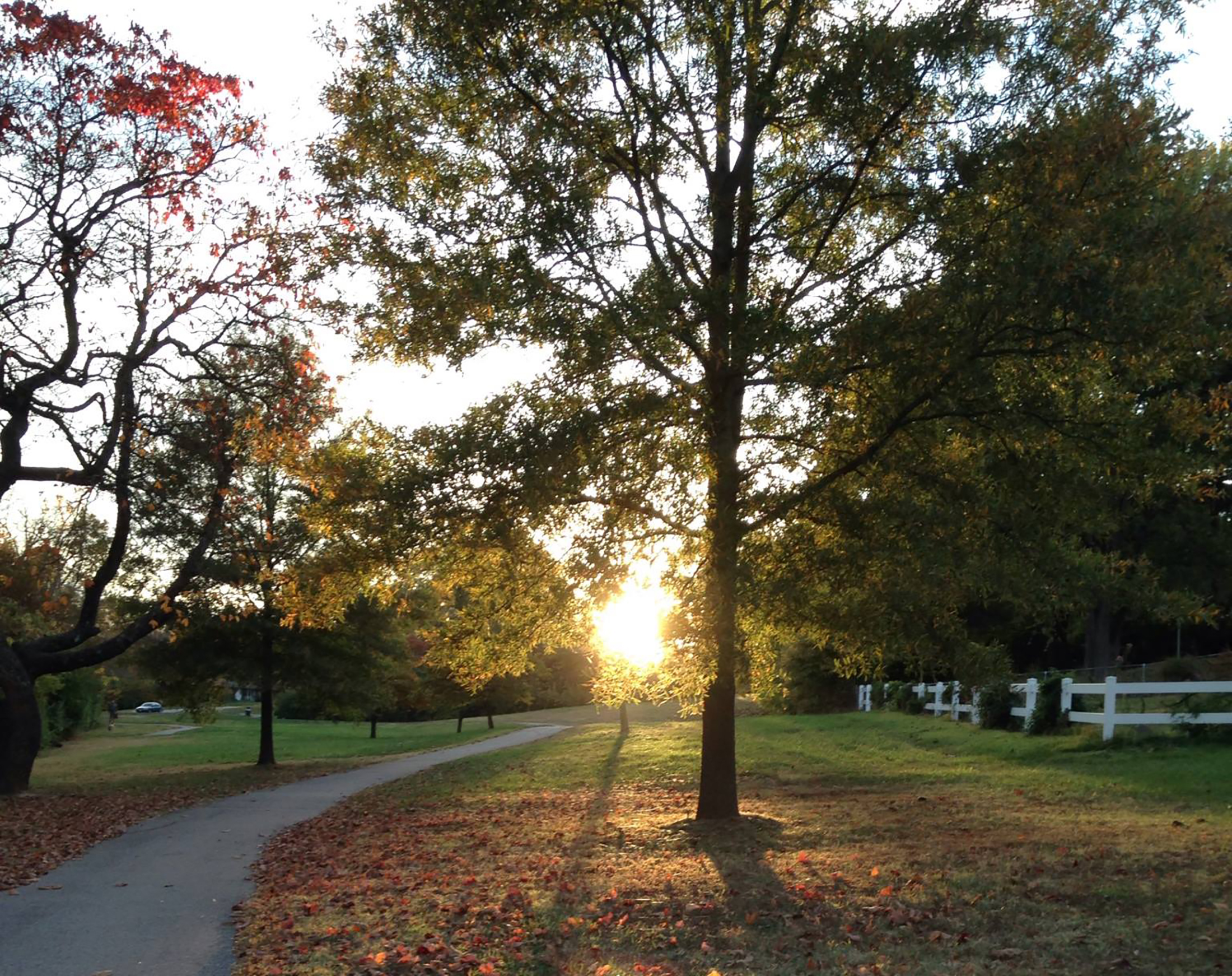
Some background: Every once in awhile, I drag myself out of bed at 5 a.m. to walk the neighborhood and watch the sun rise over South County. It’s not always pretty, but I’ve come to believe the morning is the best time of day – once I navigate the 29 steps it takes to get me from feet-hitting-floor to out-the-front-door.
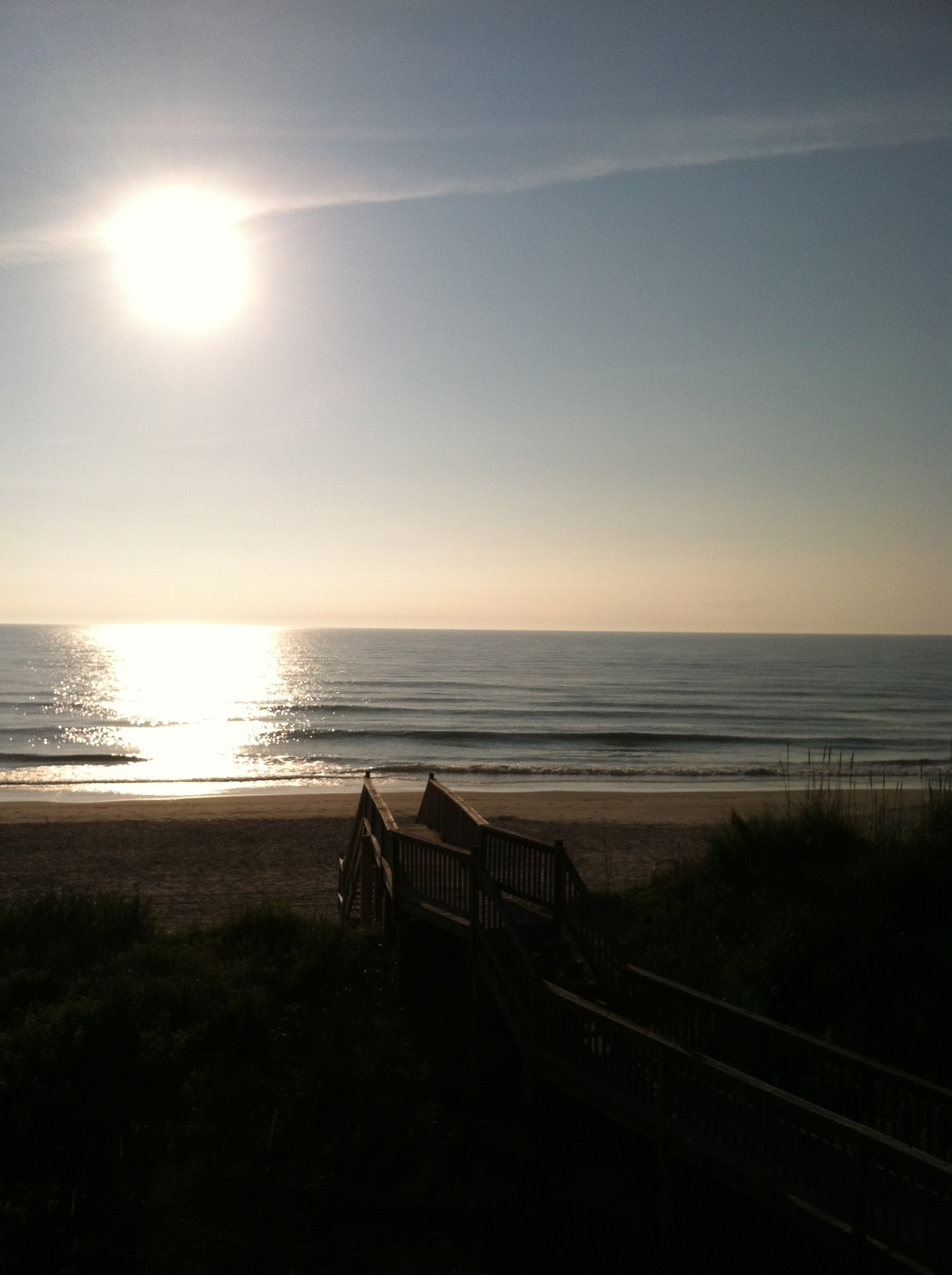
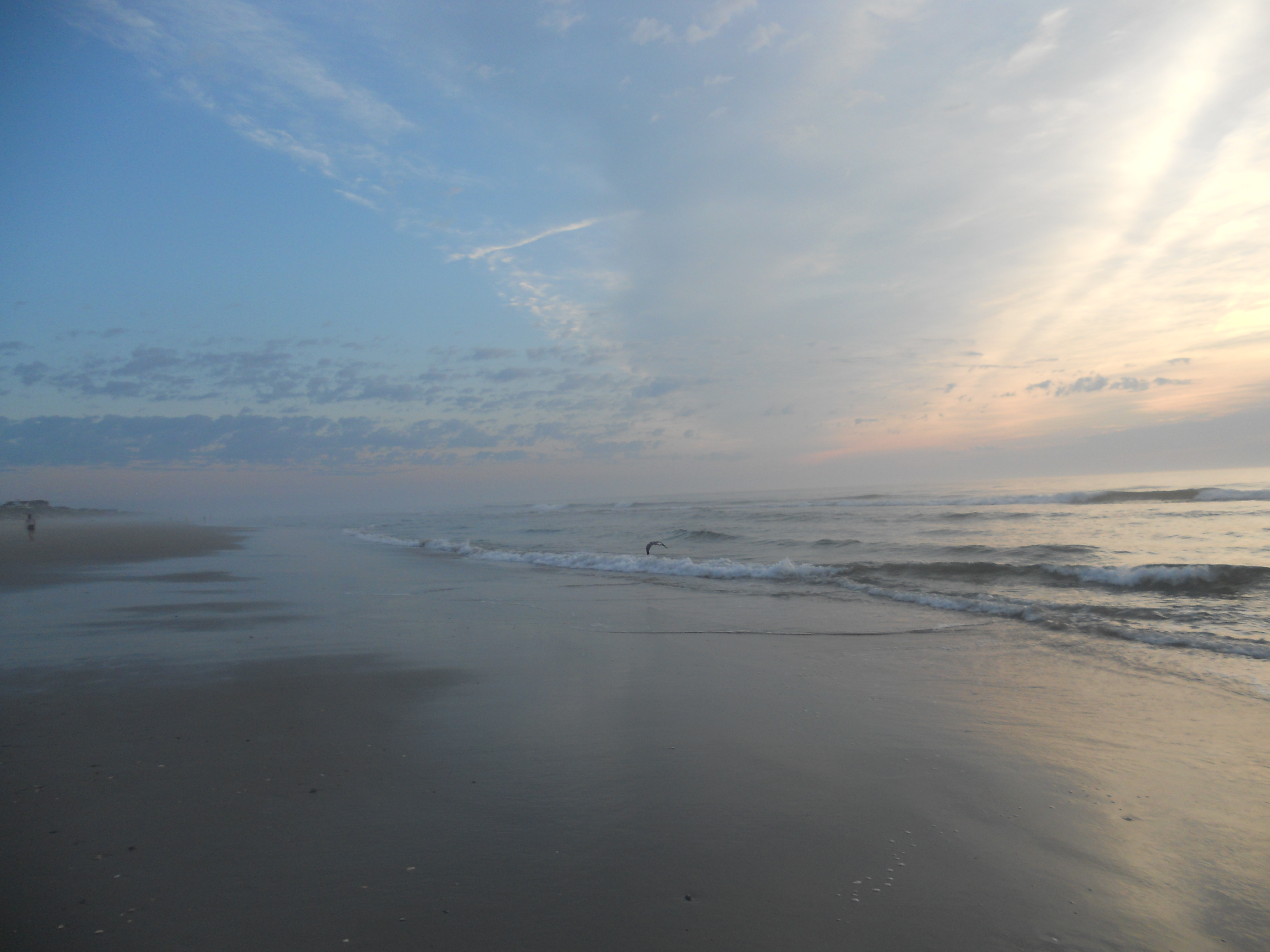
Every day for a week, I walked over this boardwalk onto the beach of Corolla, N.C., and into a kaleidoscope.
So a story about watching the sun rise over Corolla, N.C., on the Outer Banks, at about the most Eastern point of the mid-Atlantic coast of the United States. Not knowing when I would ever pass this way again, I made a promise to myself on vacation — a family reunion at a beachfront home to celebrate my Dad’s 80th birthday in the summer of 2014 — to get up while it was still dark.
The intent was to walk the beach, wait for the sun to break over the ocean’s horizon and see what the morning would bring. For five consecutive mornings from July 14-18, I watched a new day dawn over America.
Without coffee.
“That’s dangerous,” said my husband, Tom. “You want your family to know what you’re really like?”
“Are you crazy?” my sister-in-law Missy asked. “You’re on vacation!”
Indeed I was, but I’m old now — and menopausal, so sleep comes whenever it wants. And besides, there’s always the second greatest invention behind the glass of wine: the nap.
In those spectacular, early-morning hours on a beach in North Carolina, I learned a few things, among them:
Every sunrise, every day is different. Each day was like one of those kaleidoscopes you had as a kid, changing by minute not by my hands, but by God’s. Lesson learned: You think you’ve seen it all, but you haven’t.
Round and round she goes. We don’t feel the earth move beneath our feet, but it does. From the moment a glowing dot appeared on the ocean’s horizon, the movement of the sun was palpable as I literally watched it rise. Lesson learned: Don’t blink.
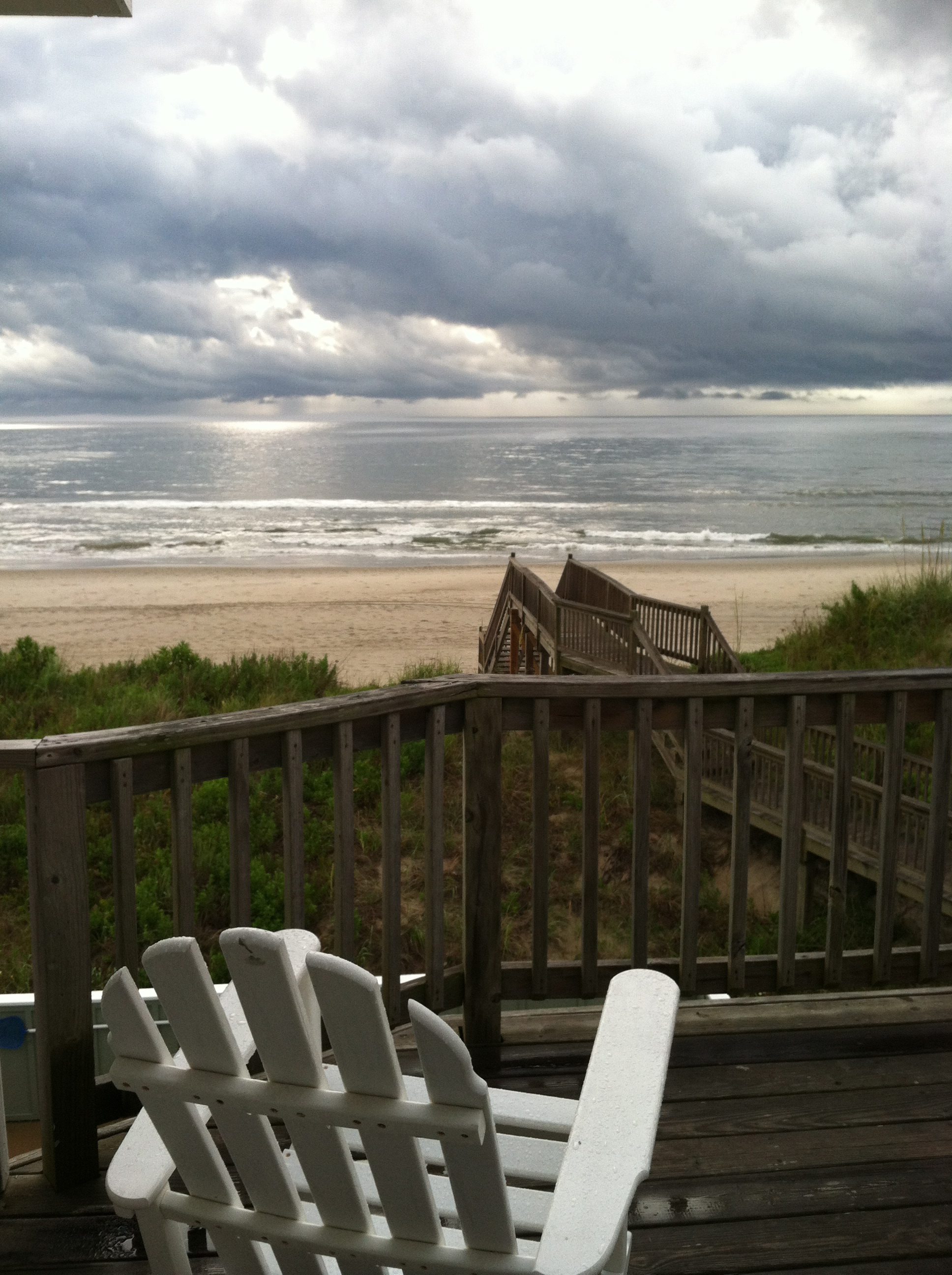
It all depends on your point of view. On Tuesday, a storm raged off the coast, what must have been a stormy ride for anyone sailing through it. Yet the sun still rose, and from where I stood its rays sprayed through the clouds like a silk hand fan. Lesson learned: Light always finds a way.
Rain? So what. The most vivid colors and most interesting images came the morning the Weather Channel claimed a washout. Lesson learned: More reliance on instinct, less worry about what computer radar says.
Each day is a fresh start. A sunrise promises each one of us a chance to start over, to begin anew. Each morning I walked up the boardwalk over the dunes back toward the house, knowing I’d be surrounded by the love of my family and Tom and my boys, and that was all that I needed.
That, and coffee.
It was among the best weeks of my life.
A version of this appeared in the Aug. 1, 2014 issue of the South County Times.
From Ellen DeGeneres and friends breaking Twitter records at the Oscars this February, to Jimmy Kimmel attempting to break that record with the Clinton Family a month later, it was hard to get away from those self-inflicted, vanity-driven, smartphone photos.
Including here. This is a story about a selfie 32 years in the making.
It begins in June 1981, a senior trip for 10 newly graduated high school girls packed into two rooms of the Aku Tiki Inn in Daytona Beach, Fla.
I still have a hard time believing our parents let us go. But it was a different era, somewhere MTV’s “Girls Gone Wild” and the 1960s “Beach Blanket Bingo.” Girls Gone Mild, maybe, if you count fake IDs and skimping on sunscreen while our mothers were home saying Hail Marys.
Every life should experience a trip like this – lying on the beach by day and dancing by night – and I’m glad I did. Plus, I’m pretty sure those Hail Marys worked. The only real danger, it turned out, was sunburn and choking on the hairspray produced by 10 girls in two rooms.
Last November, five of us returned to the Aku Tiki Inn on an unseasonably cold, gray Florida day. It was during our 50th birthday trip, a gift to our friendship, and one day we drove an hour to seek out the same hotel in which we had spent those 10 days in June.
Can you pass through a place just once and remember it like it was yesterday? The giant Tiki man above the hotel marquee said yes.
Within 20 minutes, five 50-year-old women were frolicking on the same beach on which they played at the age of 18.
That’s when we took the selfie. But first, I took a picture of the selfie-in-progress. Looking at it now, I not only can see our 18-year-old faces; I can hear Kim Carnes’ “Bette Davis Eyes” and Rick Springfield’s “Jesse’s Girl” — two songs played incessantly in clubs of the era — over and over again.
If you look closely, you can see a lot behind that selfie. All five of us are wearing sunglasses, perhaps to hide crow’s feet. The surf is churning and the wind is flipping our hair. But we’re all smiling.
At the moment it was taken, I remember thinking I could see myself on that beach 32 years earlier and wishing I could say a few things to five skinny girls lying on that beach applying iodine-infused baby oil.
For starters, I would have told them to skip the baby oil and invest in sunscreen. I might also have said something about not getting too attached to the music of Rick Springfield, but that wouldn’t have surprised anyone.
Instead, I might have said this:
You all will experience love and loss in one way or another, but be better people because of it.
You will have careers that come and go.
You will face financial hardships and emotional setbacks.
You will survive.
None of you will be wealthy, but you’ll all be rich because you’ll have children and families that matter, and friendships that endure – including one memorialized on a Florida beach.
A picture-perfect selfie.
A version of this was first published in the South County Times March 28, 2014.


 That April, I was at the Target Center in Minneapolis for the women’s national championship game between Tennessee and the University of Connecticut, seated in the first press row directly behind the Lady Vols bench. It was like having a front-row seat to every motivational informational seminar known to man – or woman. Pure, unadulterated passion mixed in spirit and intensity. And I had a 40-minute survey.